- Aits wavelength and frequeny both increases
- Bits wavelength increase but freqnency remains unchanged
- ✓its wavelength decrease but freqnency remains unchanged
- Dits wavelength and freqnency both decrease.
$\Rightarrow v_1 > v_2$
$\Rightarrow \lambda_1 f_1 > \lambda_2 f_2$
Where $f$ is the frequency
when light goes from any rarer to any denser medium frequency remain unchanged.
$\therefore f_{1}=f_{2}=f$
$\Rightarrow \lambda_1 > \lambda_2$
hence wavelength decreases but frequency remains unchanged.
Option $C$ is correct.
Generate a complete, print-ready paper with questions like this in minutes — across 16+ boards, with answer keys.
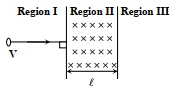
Figure: $Image$
$(A)$ The particle enters Region $III$ only if its velocity $V>\frac{q / B}{m}$
$(B)$ The particle enters Region $III$ only if its velocity $\mathrm{V}<\frac{\mathrm{q} / \mathrm{B}}{\mathrm{m}}$
$(C)$ Path length of the particle in Region $II$ is maximum when velocity $V=\frac{q / B}{m}$
$(D)$ Time spent in Region $II$ is same for any velocity $V$ as long as the particle returns to Region $I$