- AIts wavelength and frequency both increase
- BIts wavelength increases but frequency remains unchanged
- CIts wavelength decreases but frequency remains unchanged.
- DIts wavelength and frequency both decrease.
Explanation:
Frequency of a light wave, as it travels from one medium to another, always remains unchanged, while wavelength decreases.
Decrease in the wavelength of light entering a medium of refractive index $\mu$, is given by,
$\lambda_\text{M}=\frac{\lambda}{\mu},$
Where $\lambda_\text{M}$ = wavelength in medium
$\lambda$ = wavelength in vacuum
$\mu$ = refractive index
Generate a complete, print-ready paper with questions like this in minutes — across 16+ boards, with answer keys.
A steady current flows in a metallic conductor of non-uniform cross-section. The quantity/ quantities constant along the length of the conductor is/are
|
(a) Current, electric field and drift speed |
(b) Drift speed only |
|
(c) Current and drift speed |
(d) Current only |
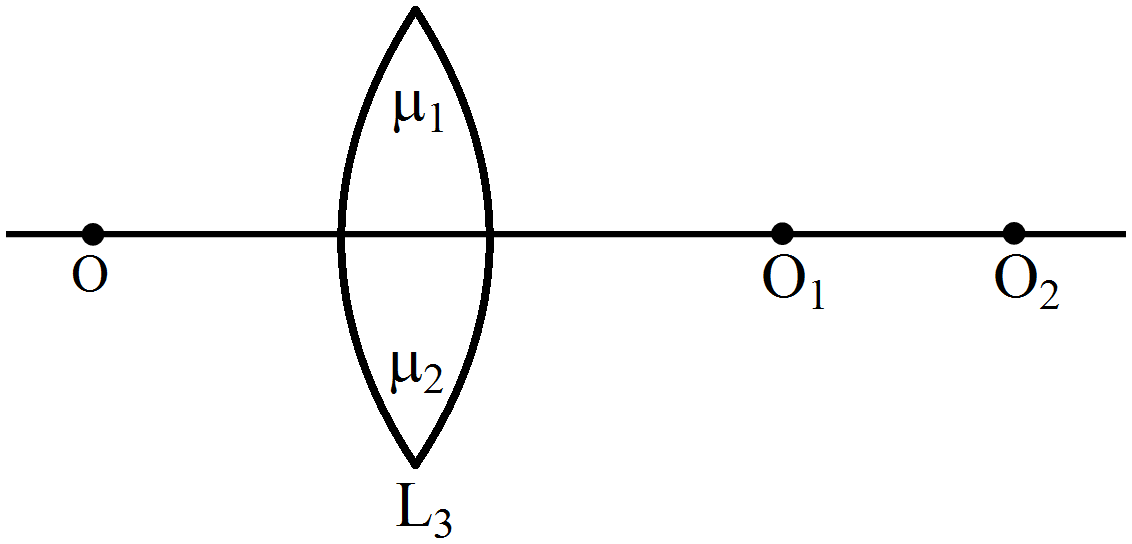
Consider three converging lenses L1, L2 and L3 having identical geometrical construction. The index of refraction of L1 and L2 are $\mu_1$ and $\mu_2$ respectively. The upper half of the lens L3 has a refractive index $\mu_1$ and the lower half has $\mu_2$. A point object O is imaged at O1 by the lens L1 and at O2 by the lens L2 placed in same position. If L3 is placed at the same place:


The magnetic induction in air at a point 1cm away from a long wire that carries a current of 1A, will be
|
(a) |
(b) 2 |
(c) 3 |
(d) 4 |

A star emitting light of wavelength 5896 Å is moving away from the earth with a speed of 3600 km /sec. The wavelength of light observed on earth will (c = 3 is the speed of light)
|
(a) Decrease by 5825.25 Å |
(b) Increase by 5966.75 Å |
|
(c) Decrease by 70.75 Å |
(d) Increase by 70.75 Å |
An electron is travelling horizontally towards east. A magnetic field in vertically downward direction exerts a force on the electron along
|
(a) East |
(b) West |
(c) North |
(d) South |