MCQ
When light is refracted from air into glass
  • A
    Its wavelength and frequency both increase
  • B
    Its wavelength increases but frequency remains unchanged
  • Its wavelength decreases but frequency remains unchanged
  • D
    Its wavelength and frequency both decrease
Answer

Correct option: C.
Its wavelength decreases but frequency remains unchanged

Need a full question paper?

Generate a complete, print-ready paper with questions like this in minutes — across 16+ boards, with answer keys.

Start Generating Free

Similar questions

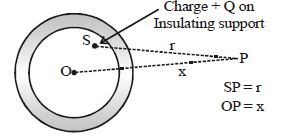
The adjacent diagram shows a charge $+Q$ held on an insulating support $S$ and enclosed by a hollow spherical conductor. $O$ represents the centre of the spherical conductor. and $P$ is a point such that $OP = x $ and $SP = r$ . The electric field at point $P$  will be
The frequency of the incident light falling on a photosensitive metal plate is doubled, the kinetic energy of the emitted photoelectrons is
The sun (diameter $d$) subtends an angle $\theta$ radian at the pole of a concave mirror of focal length $f$ . What is the diameter of the image of the sun formed by the mirror ?
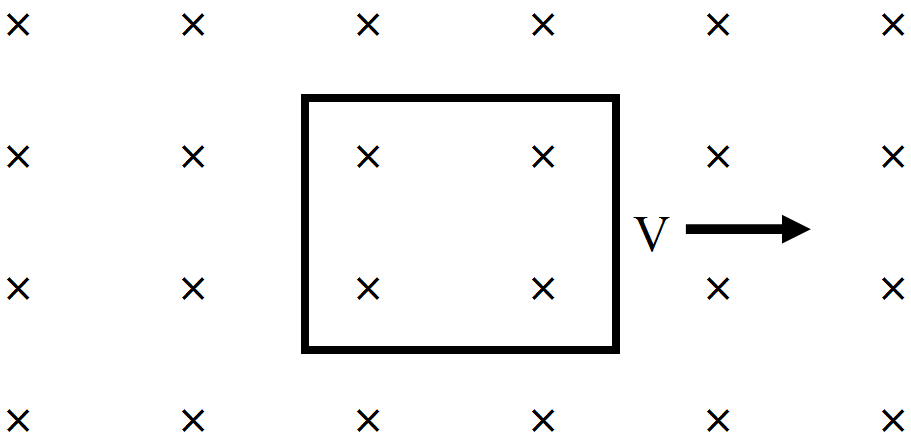
A conducting square loop of side l and resistance R moves in its plane with a uniform velocity u perpendicular to one of its sides. A uniform and constant magnetic field B exists along the perpendicular to the plane of the loop as shown in figure. The current induced in the loop is:
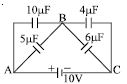
In the circuit shown in figure, four capacitors are connected to a battery. A capacitor is connected to a battery. The force of attraction between the plates when the separation between them is halved
Two charges + 5μC and +10 μC are placed 20 cm apart. The net electric field at the mid-Point between the two charges is
The frequency of electromagnetic wave in free space is $2 MHz.$ When it passes through a region of relative permittivity $\in_\text{r}=4.0,$ then its wave length $......... \&$ frequency $.........$
A body is in pure rotation. The linear speed $\nu$ of a particle, the distance r of the particle from the axis and the angular velocity $\omega$ of the body are related as $\omega=\frac{\text{v}}{\text{r}}$ Thus:
In positive logic, the logic state $1$ corresponds to:
A $6\,\mu F$ capacitor is charged from $10\;volts$ to $20\;volts$. Increase in energy will be