Question
When light travels from an optically denser medium to a rarer medium, why does the critical angle of incidence depend on the color of the light?

Answer

Refractive indices are different for different wavelengths of colour. $\mu=\frac{a+b}{\lambda^2}$, hence the value of critical angle $\sin i_c=\frac{i}{\mu}$ is also different for different colours.

Need a full question paper?

Generate a complete, print-ready paper with questions like this in minutes — across 16+ boards, with answer keys.
Start Generating Free

Similar questions

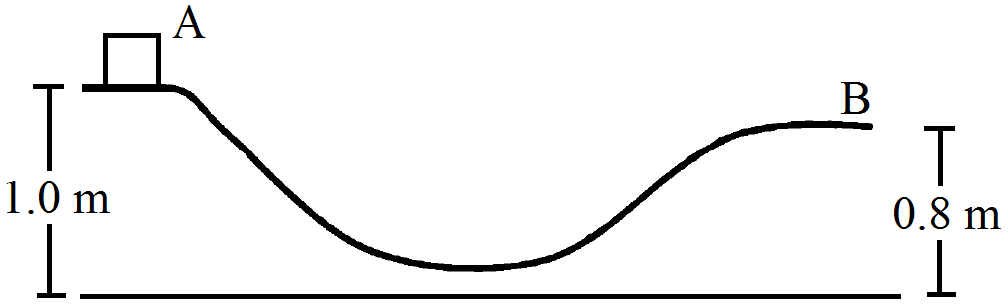
A block of mass 1kg is placed at the point A of a rough track shown in figure. If slightly pushed towards right, it stops at the point B of the track. Calculate the work done by the frictional force on the block during its transit from A to B.

Differentiate between electric lines of force and magnetic lines of force.
The bob of a simple pendulum of length 1m has mass 100g and a speed of 1.4m/s at the lowest point in its path. Find the tension in the string at this instant.
Magnetic force is always normal to the velocity of a charge and therefore does no work. An iron nail held near a magnet, when released, increases its kinetic energy as it moves to cling to the magnet. What agency is responsible for this increase in kinetic energy if not the magnetic field?
A uranium-238 nucleus, initially at rest, emits an alpha particle with a speed of 1.4 x 10⁷m/s. Calculate the recoil speed of the residual nucleus thorium-234. Assume that the mass of a nucleus is proportional to the mass number.
A railroad car of mass M is at rest on frictionless rails when a man of mass m starts moving on the car towards the engine. If the car recoils with a speed v backward on the rails, with what velocity is the man approaching the engine?
The linewidth of a bright fringe is sometimes defined as the separation between the points on the two sides of the central line where the intensity falls to half the maximum. Find the linewidth of a bright fringe in a Young's double slit experiment in terms of $\lambda$, d and D where the symbols have their usual meanings.
The maximum value of electric field vector $\overrightarrow{ E }$ in a electromagnetic wave is 0.3 mV metre$^{-1}$. Calculate the maximum value of magnetic field vector $\overrightarrow{ B }$.
An object is placed at the principal focus of a concave lens of focal length f. Where will its image be formed?
$\frac{1}{\text{f}}=\frac{1}{\text{v}}-\frac{1}{\text{u}}$
$\Rightarrow\frac{1}{\text{v}}=\frac{1}{\text{f}}+\frac{1}{\text{u}}$
Explain how the mass of an electron can be found using Millikan's oil drop experiment.