MCQ
When light travels from one medium into another it suffers:
  • A
    Reflection
  • Refraction
  • C
    Dispersion
  • D
    None of these

Answer

Correct option: B.
Refraction
When light travels from one medium into another it suffers refraction.

Need a full question paper?

Generate a complete, print-ready paper with questions like this in minutes — across 16+ boards, with answer keys.

Start Generating Free

Similar questions

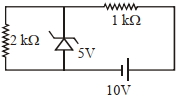
In connection with the circuit drawn below, the value of current flowing through $2\, k \Omega$ resistor is ............. $\times 10^{-4} A$
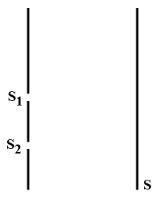
In a Young's double slit experiment, the intensity of light at each slit is $I_0$. Interference pattern is observed along a direction parallel to the line $S_1 S_2$ on screen $S$. The minimum, maximum and the intensity averaged over the entire screen are respectively.
A photon falls through a height of $1 \,km$ through the earth's gravitational field. To calculate the change in its frequency, take its mass to be $h v / c^{2}$. The fractional change in frequency $v$ is close to
When a light wave goes from air into water, the quality that remains unchanged is its
The resistance of a galvanometer is 90 ohms. If only 10 percent of the main current may flow through the galvanometer, in which way and of what value, a resistor is to be used
The phenomenon due to which a ray of light $.........$ from its path while travelling from one optical medium to another optical medium is called refraction.
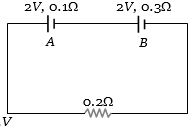
The internal resistances of two cells shown are $0.1\,\Omega $ and $0.3\,\Omega $. If $R = 0.2\,\Omega $, the potential difference across the cell
The tuning circuit of a radio receiver has a resistance of $50\,\Omega $, an inductor of $10\, mH$ and a variable capacitor. A $1\,MHz$ radio wave produces a potential difference of $0.1\,mV$. The values of the capacitor to produce resonance is.......$pF$ (Take $\pi ^2 = 10)$
Huygens' principle of secondary wavelets may be used to:
  1. Find the velocity of light in vacuum.
  2. Explain the particle behaviour of light.
  3. Find the new position of a wavefront.
  4. Explain Snell's law.
What is the electric field in the cavity of a hollow charged conductor?