MCQ
When milk is churned, cream gets separated due to
  • A
    gravitational force
  • B
    fricitional force
  • centrifugal force
  • D
    centripetal force

Answer

Correct option: C.
centrifugal force
c
Particles of cream are lighter so they get deposited near the centre of circular path.

Need a full question paper?

Generate a complete, print-ready paper with questions like this in minutes — across 16+ boards, with answer keys.

Start Generating Free

Similar questions

Two thin parallel slits are made in an opaque screen. When a monochromatic beam of light passes through them at normal incidence, the first bright fringe in the transmitted light occurs at $\pm 45^o $ with the original direction of the light beam on a distant screen when the apparatus is in air. When the apparatus is immersed in a liquid, the same bright fringe now occurs at $\pm 30^o $. The index of refraction of the liquid is
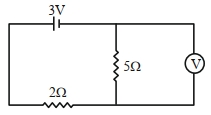
As shown in the figure, the voltmeter reads $2\,V$ across $5\,\Omega$ resistor. The resistance of the voltmeter is $.......\,\Omega$.
Yellow light is refracted through a prism producing minimum deviation. If $i_1$ and $i_2$ denote the angle of incidence and emergence for the prism, then ..........
In a semiconducting material the mobilities of electrons and holes are $\mu$$e$ and $\mu$$h$ respectively. Which of the following is true
An ice cream has a marked value of $700 \,kcal$. How many kilowatt- hour of energy will it deliver to the body as it is digested ............ $kWh$
Two point white dots are $1mm$ apart on a black paper. They are viewed by eye of pupil diameter $3\ mm$. Approximately, what is the maximum distance at which dots can be resolved by the eye ?.....$m$ [Take wavelength of light $= 500 nm$]
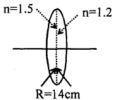
A bi-convex lens is formed with two thin plano-convex lenses as shown in the figure. Refractive index of the first lens is $1.5$ and that of the second lens is $1.2$. Both the curved surfaces are of the same radius of curvature $R = 14\; cm$. For this bi-convex lens, for an object distance of $40\; cm$, the image distance will be
Two sound waves of wavelength ${\lambda _1}$ and ${\lambda _2}$ $\left( {{\lambda _2} > {\lambda _1}} \right)$ produce $n\, beats/s$, the speed of sound is
A player with $3$ m long iron rod runs towards east with a speed of $30$ km/hr. Horizontal component of earth's magnetic field is $4 \times {10^{ - 5}}Wb/{m^2}$. If he is running with rod in horizontal and vertical positions, then the potential difference induced between the two ends of the rod in two cases will be
Four identical charges $ + \,50\,\mu C$ each are placed, one at each corner of a square of side $2\,m$. How much external energy is required to bring another charge of $ + \,50\,\mu C$ from infinity to the centre of the square......$J$ $\left( {{\rm{Given}}\frac{{\rm{1}}}{{{\rm{4}}\pi {\varepsilon _{\rm{0}}}}} = 9 \times {{10}^9}\,\frac{{N{m^2}}}{{{C^2}}}} \right)$