MCQ
When NPN transistor is used as an amplifier
  • A
     Electrons move from base to emitter
  •  Electrons move from emitter to base
  • C
    Electrons moves from base to emitter
  • D
     Holes moves from base to emitter

Answer

Correct option: B.
 Electrons move from emitter to base
 Electrons move from emitter to base

Need a full question paper?

Generate a complete, print-ready paper with questions like this in minutes — across 16+ boards, with answer keys.

Start Generating Free

Similar questions

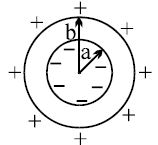
An empty thick conducting shell of inner radius $a$ and outer radius $b$ is shown in figure.If it is observed that the inner face of the shell carries a uniform charge density $-\sigma$ and the surface carries a uniform charge density $ '\sigma '$

If the charge $q_A$ is slowly moved inside the shell, then choose the statement$(s)$
Refer to figure. Let $\Delta\text{U}_1$ and $\Delta\text{U}_2$ be the changes in internal energy of the system in the processes A and B. Then,
An $LCR$ circuit contains $R = 50\, \Omega$ ,$L =\,1 \,mH $ and $C = \,0.1$ $\mu F$. The impedance of the circuit will be minimum for a frequency of
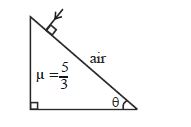
A ray of light makes normal incidence on the diagonal face of a right angled prism as shown in figure. If $\theta  = 37^o$ , then the angle of deviation is......$^o$ $(sin37^o = 3/5)$
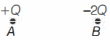
Two charges $+Q$ and $-2 Q$ are located at points $A$ and $B$ on a horizontal line as shown below.The electric field is zero at a point which is located at a finite distance
At any instant the ratio of the amount of radioactive substances is $2 : 1$. If their half lives be respectively $12$ and $16$ hours, then after two days, what will be the ratio of the substances
Indicate which one of the following system is digital
A constant voltage is applied between the two ends of a metallic wire. If both the length and the radius of the wire are doubled, the rate of heat developed in the wire
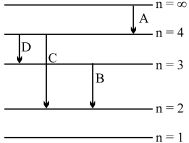
Consider the following electronic energy level diagram of $H-$ atom: Photons associated with shortest and longest wavelengths would be emitted from the atom by the transitions labelled:
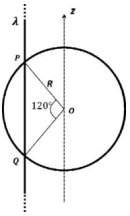
An infinitely long thin non-conducting wire is parallel to the $z$-axis and carries a uniform line charge density $\lambda$. It pierces a thin non-conducting spherical shell of radius $R$ in such a way that the arc $PQ$ subtends an angle $120^{\circ}$ at the centre $O$ of the spherical shell, as shown in the figure. The permittivity of free space is $\in_0$. Which of the following statements is (are) true?

$(A)$ The electric flux through the shell is $\sqrt{3} R \lambda / \in_0$

$(B)$ The z-component of the electric field is zero at all the points on the surface of the shell

$(C)$ The electric flux through the shell is $\sqrt{2} R \lambda / \in_0$

$(D)$ The electric field is normal to the surface of the shell at all points