Question
When our body encounters a pathogen for the first time, the immune response is generally low, but on exposure to the same pathogen again, the immune response by the body is much more compared to the first exposure. Why is it so?

Answer

When our body faces a pathogen (like a virus or bacteria) for the first time, our immune system needs time to:
• Identify the invader
• Create specific antibodies
• Build memory cells that remember the pathogen
This first reaction is called the primary immune response, and it’s usually slow and weak.
When the same pathogen enters our body again:
• Our memory B cells quickly produce the correct antibodies
• Our memory T cells help destroy infected cells faster
This is called the secondary immune response, and it’s faster, stronger, and more effective.

Need a full question paper?

Generate a complete, print-ready paper with questions like this in minutes — across 16+ boards, with answer keys.
Start Generating Free

Similar questions

Draw a labelled diagram of larynx and explain its functions.
Identify the actions involved in the following situations as push or pull, or both:
$a.$ Opening a drawer.
$b.$ A cricket ball hit by a batsman.
$c.$ Drawing a bucket of water from a well.
$d.$ moving a book placed on a table.
$e.$ A football player taking a penalty corner.
$f.$ Moving a wheel barrow.
If the materials used for constructing a building were good conductors, do you think lightning will strike the building. Will the lightning conductor be still required to be installed in the building?
Name any four pollutants which cause water pollution. State any three ways of controlling water pollution.
State five uses of metals and five uses of non$-$metals.
Which plastic is used:
$a.$ For making uniforms of fire$-$men fire resistant?
$b.$ For giving non-stick coating on frying pans?
$c.$ For making handles of frying pans?
$d.$ For making insulation $($covering$)$ of electric wires?
$e.$ For making electric switches?
$f.$ For making flexible water bottles?
Find out about such community campaigns held in your location. Share in your class and discuss with your peers about the impact of such initiatives.
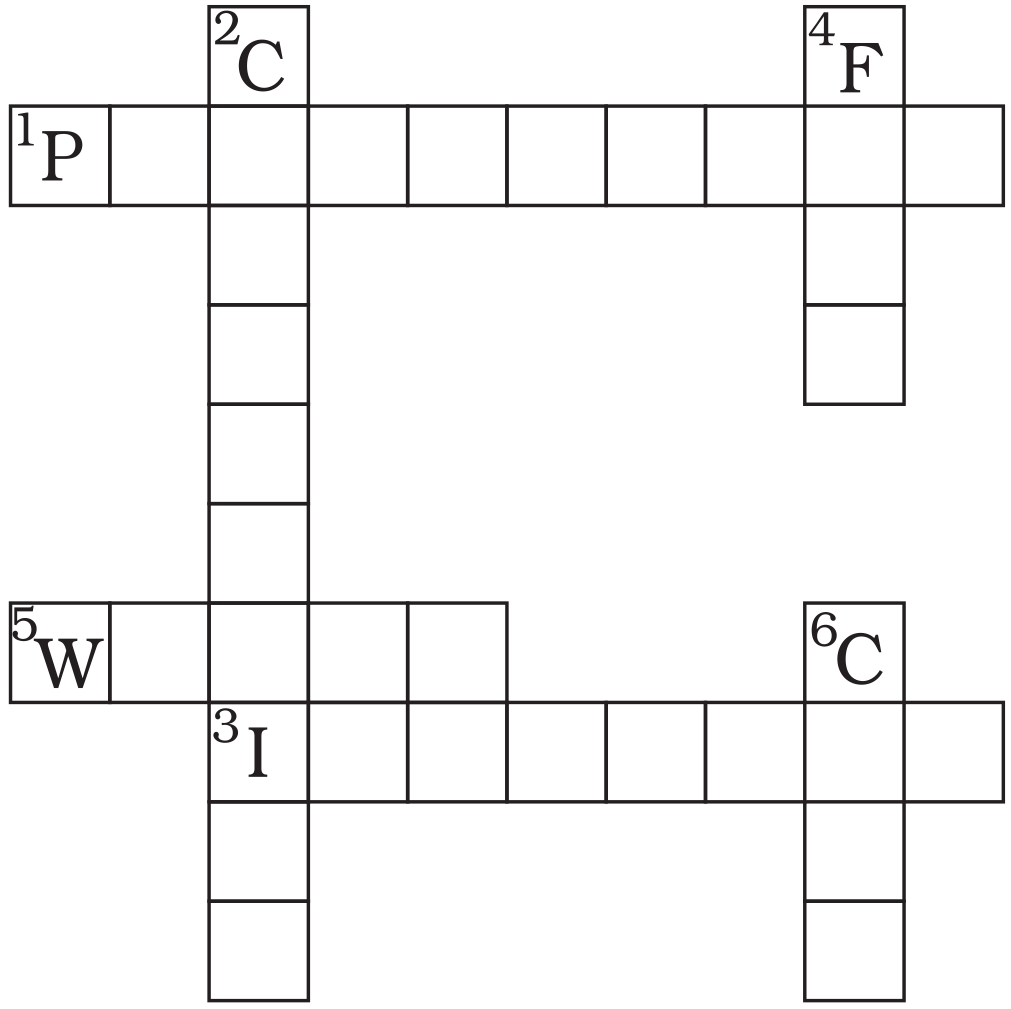
Complete the crossword Fig. with the help of the clues:

Across
$1.$ Non$-$metal which catches fire if exposed to air. $(10)$
$3.$ The lowest temperature at which a substance catches fire is called its $………$ temperature. $(8)$
$5.$ The most common fire extinguisher. $(5)$
Down
$2.$ A chemical process in which a substance reacts with oxygen to give off heat. $(10)$
$4.$ Petrol is used as a $……..$ in automobiles. $(4)$
$6.$ It is as hard as stone and black in colour. $(4)$
Describe how scientific principles help us understand the relationship between Moon phases and timekeeping. How did observations of celestial cycles influence early calendars and our routines on Earth?
Snehal dug two pits, A and B, in her garden. In pit A, she put fruit and vegetable peels and mixed them with dried leaves. In pit B, she dumped the same kind of waste without mixing it with dried leaves. She covered both the pits with soil and observed after 3 weeks. What is she trying to test?