MCQ
When potential difference is applied across an electrolyte, then Ohm's law is obeyed at:
- AZero potential.
- BVery low potential.
- CNegative potential.
- DHigh potential.
Explanation:
When voltage is applied to an electrolyte, dissociation of ions starts.
At low voltages as the voltage increases the number of ions conducting also increases making a non linear increase of current.
After a certain voltage when the ions are dissociated and no more dissociation, the electrolyte behaves as a conductor and obeys ohm's law.
Thus at high voltages, an electrolyte obeys ohm's law.
Generate a complete, print-ready paper with questions like this in minutes — across 16+ boards, with answer keys.
In the circuit shown in figure, each capacitor has a capacity of 3μF. The equivalent capacity between A and B is
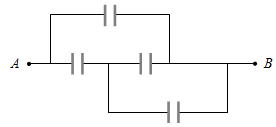
|
(a) |
(b) 3 |
(c) 6 |
(d) 5 |
Point charges +4q, -q and +4q are kept on the x - axis at points x = 0, x = a and x = 2a respectively, then
|
(a) Only q is in stable equilibrium |
(b) None of the charges are in equilibrium |
|
(c) All the charges are in unstable equilibrium |
(d) All the charges are in stable equilibrium |
A coil of 100 turns and area 5 square centimetre is placed in a magnetic field B = 0.2 T. The normal to the plane of the coil makes an angle of 60° with the direction of the magnetic field. The magnetic flux linked with the coil is
|
(a) 5 |
(b) 5 |
(c) |
(d) |
Two different metals are joined end to end. One end is kept at constant temperature and the other end is heated to a very high temperature. The graph depicting the thermo e.m.f. is
|
(a)
|
(b)
|
(c)
|
(d)
|
The amount of substance liberated on electrodes during electrolysis when 1 coulomb of electricity is passed, is
|
(a) Chemical equivalent |
(b) Electrochemical equivalent |
|
(c) Equivalent weight |
(d) One mol |


