MCQ
When red glass is heated in dark room it will seem
  • Green
  • B
    Purple
  • C
    Black
  • D
    Yellow

Answer

Correct option: A.
Green
a
(a) Red and green colours are complementary to each other.

When red glass is heated it absorbs green light strongly, hence according to Kirchoff’s law, the emissive power of red glass should be maximum for green light.

That’s why when this heated red glass is taken in dark room it strongly emits green light and looks greenish.

Need a full question paper?

Generate a complete, print-ready paper with questions like this in minutes — across 16+ boards, with answer keys.
Start Generating Free

Similar questions

Current in the circuit is wattless, if
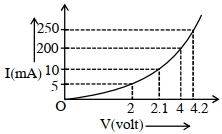
The $I-V$ characteristics of a $p - n$ junction diode in forward bias is shown in the figure. The ratio of dynamic resistance, corresponding to forward bias voltages of $2 \; V$ and $4 \; V$ respectively, is
In the relation : $\frac{d y}{d x}=2 \omega \sin \left(\omega t+\phi_0\right)$ the dimensional formula for $\left(\omega t+\phi_0\right)$ is :
An elementary particle of mass $m$ and charge $+e$ is projected with velocity $v$ at a much more massive particle of charge $Ze$, where $Z > 0$. What is the closest possible approach of the incident particle
The ratio of the distances of two planets from the sun is $1.38$. The ratio of their period of revolution around the sun is
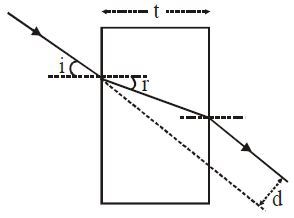
A ray of light is incident on a thick slab of glass of thickness $t$ as shown in the figure.  The  emergent ray is parallel to the incident ray but displaced sideways by a distance $d$. If  the angles are small then $d$ is
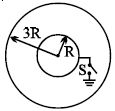
Two thin conducting shells of radii $R$ and $3R$ are shown in the figure. The outer shell carries a charge $+ Q$ and the inner shell is neutral. The inner shell is earthed with the help of a switch $S$.
The unit of power is
In $YDSE$, $16$ fringes occupy a certain region of space with light of wavelength $6000\,\mathop A\limits^o $. If $24$ fringes occupy the same region, wavelength of new light is........$\mathop A\limits^o $
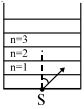
$A$ point source $S$ is placed at the bottom of different layers as shown in the figure. The refractive index of bottom most layer is $\mu_0$. The refractive index of any other upper layer is $\mu (n) = \mu_0$ $-\frac{{{\mu _0}}}{{4n - 18}}$  where $n = 1, 2........$, $A$ ray of light with angle i slightly more than $30^o$ starts from the source $S$. Total internal reflection takes place at the upper surface of a layer having $n$ equal to