Question
When small drops of water are sprayed, why is cooling produced?

Answer

Spraying in small drops increases the surface area. Therefore, there is an increase in the surface energy but in this work there is a decrease in the internal energy (because the total energy is conserved). Hence, the fall in temperature produces coolness, which we experience in daily life. Feeling more cold while bathing under a water fountain is an example of this.

Need a full question paper?

Generate a complete, print-ready paper with questions like this in minutes — across 16+ boards, with answer keys.
Start Generating Free

Similar questions

The decay constant of $\text{ }^{197}_{80}\text{Hg} ($electron capture to $\text{ }^{197}_{79}\text{Au})$ is $1.8 \times 10^{-4} S^{-1}$.
  1. What is the half$-$life?
  2. What is the average$-$life?
  3. How much time will it take to convert $25\%$ of this isotope of mercury into gold?
What is the specific heat capacity of :
  1. Melting ice
  2. Boiling water?
If x = at + bt, where x is in metre and t in hour, what will be the unit of 'a' and 'b'?
Is nuclear mass density dependent on the mass number? $(\text{Given}: \text{r} = \text{r}_0 \text{A}^{\frac{1}{3}})$
Rule out or accept the following formulae for kinetic energy on the basis of dimensional arguments.
  1. $\text{K}=\frac{3}{16}\text{mv}^2$
  2. $\text{K}=\frac{1}{2}\text{mv}^2+\text{ma}$
  3. $\text{K}=\frac{1}{2}\text{mv}^2$
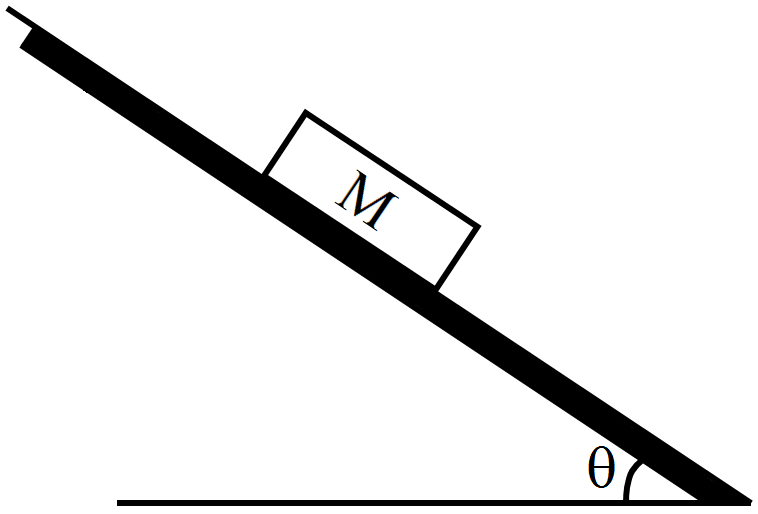
A block of mass M is placed on a frictionless, inclined plane of angle $\theta,$ as shown in the figure. Determine the acceleration of the block after it is released. What is force exerted by the incline on the block?
A barometer tube is 80cm long (above the mercury reservoir). It reads 76cm on a particular day. A small amount of water is introduced in the tube and the reading drops to 75.4cm. Find the relative humidity in the space above the mercury column if the saturation vapour pressure at the room temperature is 1.0cm.
The displacement of the particle at x = 0 of a stretched string carrying a wave in the positive x-direction is given by $\text{f(t)}=\text{a}\sin\Big(\frac{\text{t}}{\text{T}}\Big).$ The wave speed is v. Write the wave equation.
Blood is flowing 0.1 cm long and $2 \times 10^{-4}$ cm radius in the tube. The pressure difference at the ends of this tube is 20 mm mercury. Coefficient of viscosity of blood is $0.5 \times 10^3 kg m ^{-1} sec ^{-1}$. Find the rate of blood flow in the tube.