Question
When some wax is rubbed on a cloth, it becomes waterproof. Explain.

Answer

A liquid wets a surface when the angle of contact of the liquid with the surface is small or zero. Due to its fibrous nature, cloth produces capillary action when in contact with water. This makes clothes have very small contact angles with water. When wax is rubbed over cloth, the water does not wet the cloth because wax has a high contact angle with water.

Need a full question paper?

Generate a complete, print-ready paper with questions like this in minutes — across 16+ boards, with answer keys.
Start Generating Free

Similar questions

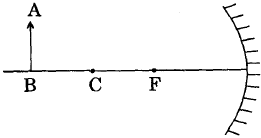
An object AB is kept in front of a concave mirror as shown in the figure.

  1. Complete the ray diagram showing the image formation of the object.
  2. How will the position and intensity of the image be affected if the lower half of the mirror's reflecting surface is painted black?
An electric dipole of length 2 cm is placed in an electric field of intensity $10^5$ Newton/Coulomb in such a way that its axis makes an angle of $30^{\circ}$ with the direction of the field. A torque of $10 \sqrt{3}$ Newton meter acts on it. Find the magnitude of charge on the electric diple.
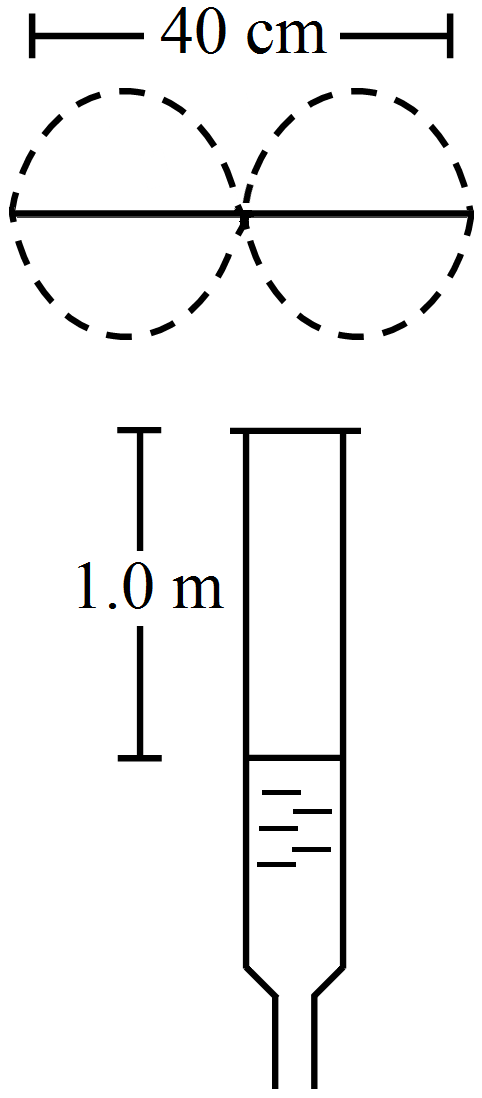
Consider the situation shown in figure. The wire which has a mass of 4.00g oscillates in its second harmonic and sets the air column in the tube into vibrations in its fundamental mode. Assuming that the speed of sound in air is 340m/s, find the tension in the wire.

Draw a graph showing the change in potential corresponding to the change in distance from a point charge. For the charged system shown in the figure, prove that the potential difference between points $A$ and $B$ is
Image
In pair annihilation, an electron and a positron destroy each other to produce gamma radiation. How is the momentum conserved?
Explais the arrangements for conducting an experimental study of the photoelectric effect.
A container contains water upto a height of 20cm and there is a point source at the centre of the bottom of the container. A rubber ring of radius r floats centrally on the water. The ceiling of the room is 2.0m above the water surface.
  1. Find the radius of the shadow of the ring formed on the ceiling if r = 15cm.
  2. Find the maximum value of r for which the shadow of the ring is formed on the ceiling. Refractive index of water $\frac{4}{3}.$
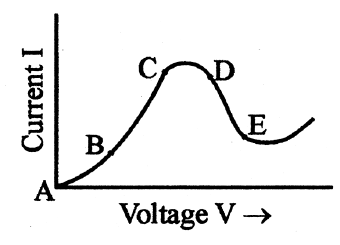
Graph showing the variation of current versus voltage for a material GaAs is shown in the figure. Identify the region of.
  1. Negative resistance.
  2. Where Ohm's law is obeyed.
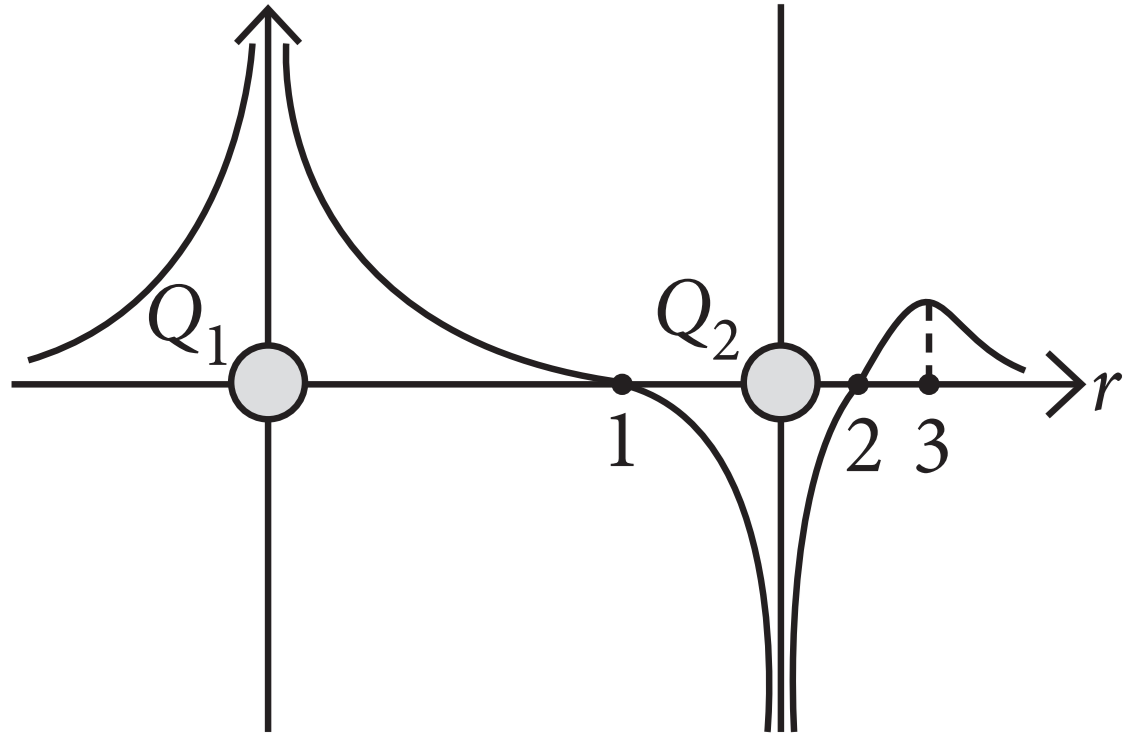
The potential at any observation point P of a static electric field is defined as the work done by the external agent (or negative of work done by electrostatic field) in slowly bringing a unit positive point charge from infinity to the observation point. Figure shows the potential variation along the line of charges. Two point charges Q1 and Q2 lie along a line at a distance from each other.

  1. At which of the points 1, 2, and 3 is the electric field is zero?
  1. 1
  2. 2
  3. 3
  4. Both (a) and (b)
  1. The signs of charges Q1 and Q2 respectively are:
  1. Positive and negative.
  2. Negative and positive.
  3. Positive and positive.
  4. Negative and negative.
  1. Which of the two charges Q1 and Q2 is greater in magnitude?
  1. Q2
  2. Q1
  3. Same.
  4. Can't determined.
  1. Which of the following statement is not true?
  1. Electrostatic force is a conservative force.
  2. Potential energy of charge q at a point is the work done per unit charge in bringing a charge from any point to infinity.
  3. When two like charges lie infinite distance apart, their potential energy is zero.
  4. Both (a) and (c).
  1. Positive and negative point charges of equal magnitude are kept at $\Big(0,0,\frac{\text{a}}{2}\Big)$ and $\Big(0,0,\frac{\text{-a}}{2}\Big)$ respectively.

The work done by the electric field when another positive point charge is moved from (-a, 0, 0) to (0, a, 0) is to:

  1. Positive.
  2. Negative.
  3. Zero.
  4. Depends on the path connecting the initial and final positions.
A metal rod is placed along the axis of a solenoid carrying a high-freqμency alternating current. It is found that the rod gets heated. Explain why the rod gets heated.