Question
When some wax is rubbed on a cloth, it becomes waterproof. Explain.

Answer

A liquid wets a surface when the angle of contact of the liquid with the surface is small or zero. Due to its fibrous nature, cloth produces capillary action when in contact with water. This makes clothes have very small contact angles with water. When wax is rubbed over cloth, the water does not wet the cloth because wax has a high contact angle with water.

Need a full question paper?

Generate a complete, print-ready paper with questions like this in minutes — across 16+ boards, with answer keys.
Start Generating Free

Similar questions

The distance between the centres of two insulated charged copper spheres ' $A$ ' and ' $B$ ' which are identical in size is 50 cm and the charge on each is $6.5 \times 10^{-7} C$. A third uncharged sphere ' C ' of the same size was first brought in contact with the sphere ' $A$ ', and then brought in contact with the second sphere ' $B$ ' and finally separated from both. Then find the magnitude of repulsive foce between ' $A$ ' and ' $B$ '.
A lady cannot see objects closer than 40cm from the left eye and closer than 100cm from the right eye. While on a mountaineering trip, she is lost from her team. She tries to make an astronomical telscope from her reading glasses to look for her teammates.
  1. Which glass should she use as the eyepiece?
  2. What magnification can she get with relaxed eye?
Explain (/ Discuss) the variation in intensity of the light transmitted through two polaroids. And from that derive Malus' law.
(a) What will be the charge on $12.5 \times 10^8$ electrons?(b) Which is larger between 1 Coulomb charge and 1 electron charge? How many electronic charges will there be in one Coulomb charge?
Calculate $\frac{\text{n(T)}}{\text{n}(1000\text{K})}$ for tungsten emitter at T = 300K, 2000K and 3000K, where n(T) represents the number of thermions emitted per second by the surface at temperature T. Work function of tungsten is 4.52eV.
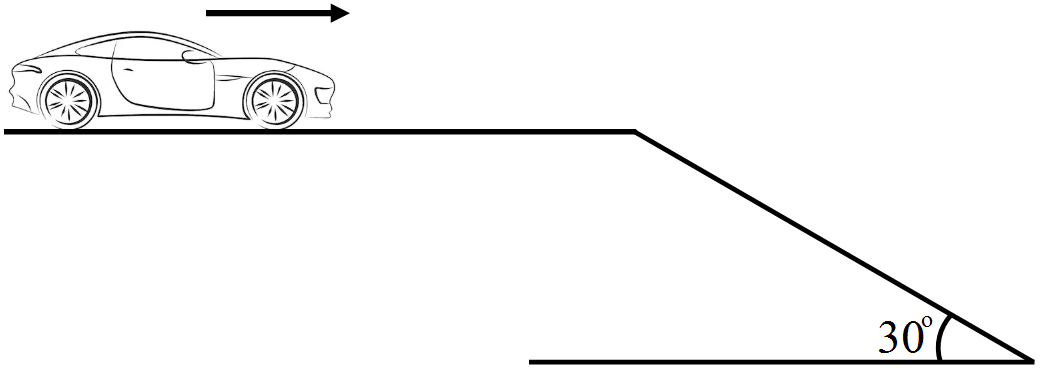
A car is going at a speed of 21.6km/hr when it encounters a 12.8m long slope of angle 30°. The friction coefficient between the road and the tyre is $\frac{1}{2\sqrt{3}}.$ Show that no matter how hard the driver applies the brakes, the car will reach the bottom with a speed greater than 36km/hr. Take $g = 10m/s^2.$
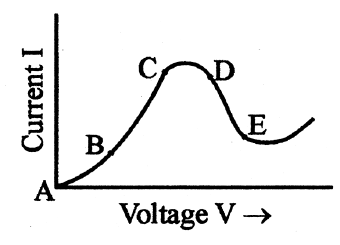
Graph showing the variation of current versus voltage for a material GaAs is shown in the figure. Identify the region of.
  1. Negative resistance.
  2. Where Ohm's law is obeyed.
The magnetic field at a point, 10cm away from a magnetic dipole, is found to be $2.0 \times 10^{-4}T$. find the magnetic moment of the dipole if the point is.
  1. In end-on position of the dipole.
  2. In broadside-onposition of the dipole.
Consider a gravity-free hall in which an experimenter of mass 50kg is resting on a 5kg pillow, 8ft above the floor of the hall. He pushes the pillow down so that it starts falling at a speed of 8ft/s. The pillow makes a perfectly elastic collision with the floor, rebounds and reaches the experimenter's head. Find the time elapsed in the process.
A bar magnet has a length of 8cm. The magnetic field at a point at a distance 3cm from the centre in the broadside-on position is found to be $4 \times 10^{-6} T.$ Find the pole strength of the magnet.