MCQ
When $\text{CH}_3-\text{C}\equiv\text{CH}$ reacts with one mole of $\text{HBr}$ then product obtained is :
  • A
    Bromoethene.
  • B
    Dibromopropane.
  • $2-$ bromopropene.
  • D
    $1-$ bromopropane.

Answer

Correct option: C.
$2-$ bromopropene.
$ \ \ \ \ \ \ \ \ \ \ \ \ \ \ \ \ \ \ \ \ \ \ \ \ \ \ \ \ \ \ \ \ \ \ \ \ \ \ \ \ \ \ \ \ \ \ \ \ \ \ \ \ \ \ \ \ \ \ \text{Br}\\ \ \ \ \ \ \ \ \ \ \ \ \ \ \ \ \ \ \ \ \ \ \ \ \ \ \ \ \ \ \ \ \ \ \ \ \ \ \ \ \ \ \ \ \ \ \ \ \ \ \ \ \ \ \ \ \ \ \ \ |\\\text{CH}_3-\text{C}\equiv\text{CH}+\text{HBr}\rightarrow\text{CH}_2=\text{C}-\text{CH}_3\\ \ \ \ \ \ \ \ \ \ \ \ \ \ \ \ \ \ \ \ \ \ \ \ \ \ \ \ \ \ \ \ \ \ \ \ \ \ \ \ \ \ \ \ \ \ \ \ \ \ _{2-\text{bromopropene}}$

Need a full question paper?

Generate a complete, print-ready paper with questions like this in minutes — across 16+ boards, with answer keys.

Start Generating Free

Similar questions

Dry distillation of sodium propanoate with sodalime gives
Which of the following compounds will react with $Na$ to form $4,5-$ diethyloctane ?
Calculate the $\Delta _fH^o$ of $N_2H_4(g)$ if

$B.E(N -N) = 159\, kJ\, mol^{-1}$,

$B.E(H -H) = 436\, kJ\, mol^{-1}$

$B.E.(N \equiv  N) = 941\, kJ\, mol^{-1}$,

$B.E(N -H) = 398\, kJ\, mol^{-1}\, .......\,kJ\, mol^{-1}$

$Ph - C \equiv CH\xrightarrow[{\left( {Excess} \right)}]{{HCl}}X\xrightarrow{{KOH\left( {aq.} \right)}}Y\xrightarrow{{C{H_3} - C{H_2}}}Z,$

$Z$ is known as

The wavelngth of radiation emitted when electron falls from $4^{th}$ Bohr orbit to $2^{nd}$ in $H$ atom is .............. $\mathrm{nm}$
Molecular $AB$ has a bond length of $1.61\,\mathop A\limits^o $ and a dipole moment of $0.38\, D$. The fractional charge on each atom (absolute magnitude) is $(e_0\, = 4.802\times10^{-10}\, esu)$
According to the Avogadro's Law, equal volumes of two different gases, under same conditions of temperature and pressure, contain equal number of :
Which of the following options are correct for the reaction

$2\left[ Au ( CN )_2\right]_{( aq )}^{-}+ Zn ( s ) \rightarrow 2 Au ( s )+\left[ Zn ( CN )_4\right]_{( aq )}^{2-}$

$A.$ Redox reaction

$B.$ Displacement reaction

$C.$ Decomposition reaction

$D.$ Combination reaction

Choose the correct answer from the options given below:
Aluminium chloride exists as dimer, $A{l_2}C{l_6}$ in solid state as well as in solution of non-polar solvents such as benzene. When dissolved in water, it gives
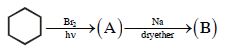
Product $B$ is