When the current flowing in a circular coil is doubled and the number of turns of the coil in it is halved, the magnetic field at its centre will become
Easy
Download our app for free and get started
(b) $B = \frac{{{\mu _0}}}{{4\pi }}.\frac{{2\pi ni}}{r} \Rightarrow B \propto ni$

Download our appand get started for free
Experience the future of education. Simply download our apps or reach out to us for more information. Let's shape the future of learning together!No signup needed.*
Similar Questions
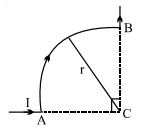
- 1A wire carrying $I$ is shaped as shown. Section $AB$ is a quarter circle of radius $r.$ The magnetic field at $C$ is directedView Solution
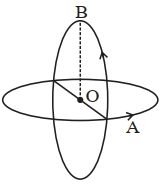
- 2Two insulated circular loop $A$ and $B$ radius ' $a$ ' carrying a current of ' $\mathrm{I}$ ' in the anti clockwise direction as shown in figure. The magnitude of the magnetic induction at the centre will be :View Solution
- 3A charge $Q$ is moving $\overrightarrow{dl}$ distance in the magnetic field $\overrightarrow{ B }$. Find the value of work done by $\overrightarrow{ B }$.View Solution
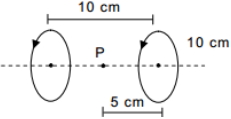
- 4Two circular loops having same radius $[ R =10\, cm ]$ and same current $\frac{7}{2} A$ are placed along same axis as shown. If distance between their centre is $10\, cm$, find net magnetic field at of point $P.$View Solution
- 5An electric field of $1500\, V/m$ and a magnetic field of $0.40\, weber/metre^2$ act on a moving electron. The minimum uniform speed along a straight line the electron could have isView Solution
- 6A $50\, ohm$ galvanometer gets full scale deflection when a current of $0.01\, A$ passes through the coil. When it is converted to a $10\, A$ ammeter, the shunt resistance is ........... $\Omega $View Solution
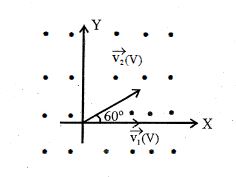
- 7Two charged particles of mass $m$ and charge $q$ each are projected from origin simultaneously with same speed $V$ in transverse magnetic field. If ${\vec r_1}$ and ${\vec r_2}$ are the position vectors of particles (with respect to origin) at $t = \frac{{\pi m}}{{qB}}$ then the value of ${\vec r_1}.{\vec r_2}$ at that time isView Solution
- 8In a moving coil galvanometer, the deflection of the coil $\theta $ is related to the electrical current $i$ by the relationView Solution
- 9When a current of $5\ mA$ is passed through a galvanometer having a coil of resistance $15\ \Omega$, it shows full scale deflection. The value of the resistance to be put in series with the galvanometer to convert it into to voltmeter of range $0 - 10\ V$ isView Solution
- 10View SolutionIn a region, steady and uniform electric and magnetic fields are present. These two fields are parallel to each other. A charged particle is released from rest in this region. The path of the particle will be a