MCQ
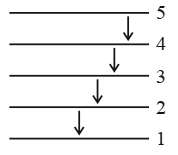
When the excited electron of a $H$ atom from $n =5$ drops to the ground state, the maximum number of emission lines observed are$.......$
  • A
    $15$
  • B
    $16$
  • $10$
  • D
    $8$

Answer

Correct option: C.
$10$
c
Maximum number of emission lines from $\mathrm{n}^{\text {th }}$ energy state to ground state is given by:

$=\frac{\mathrm{n}(\mathrm{n}-1)}{2}=\frac{5(5-1)}{2}=\frac{20}{2}=10 \text { lines. }$
Need a full question paper?

Generate a complete, print-ready paper with questions like this in minutes — across 16+ boards, with answer keys.
Start Generating Free

Similar questions

How many compounds among the following compounds show inductive, mesomeric as well as hyperconjugation effects?
The correct increasing order of adjacent bond angle among $BF_3 ,PF_3$ and $ClF_3$
Assume carbon burns according to following equation :

$2 C _{( s )}+ O _{2( g )} \rightarrow 2 CO ( g )$

When $12\,g$ carbon is burnt in $48\,g$ of oxygen, the volume of carbon monoxide produced is $......\times 10^{-1}\,L$ at STP [nearest integer]

[Given : Assume $CO$ as ideal gas, Mass of $C$ is $12\,g\,mol ^{-1}$, Mass of $O$ is $16\,g\,mol ^{-1}$ and molar volume of an ideal gas at STP is $22.7\,L\, mol ^{-1}$ ]

Among the following species which two have trigonal pyramidal shape ?

$(I)$ $NI_3$                    $(II)$ $I_3^-$   

$(III)$ $SO_3^{-2}$         $(IV)$ $NO_3^-$

Consider the given chemical reaction :

Product "$A$" is :

The electronic configuration of an element is $1{s^2},\,2{s^2}\,2{p^6},\,3{s^2}\,3{p^3}$. What is the atomic number of the element which is just below the above element in the periodic table
$0.01$ moles of a weak acid $HA \left( K _{ a }=2.0 \times 10^{-6}\right)$ is dissolved in $1.0\, L$ of $0.1\, M\, HCl$ solution. The degree of dissociation of $HA$ is ............. $\times 10^{-5}$

(Round off to the Nearest Integer).

[Neglect volume change on adding $HA$. Assume degree of dissociation $<< 1]$

Acetylene molecules contain
Decreasing order of bond angle is
'At constant temperature, the pressure of a fixed amount of gas varies inversely with its volume'. This law is known as :