MCQ
When the intensity of a light source is increased:
  • A
    The number of photons emitted by the source in unit time increases.
  • B
    The total energy of the photons emitted per unit time increases.
  • C
    More energetic photons are emitted.
  • D
    Faster photons are emitted.

Answer

  1. The number of photons emitted by the source in unit time increases.
  2. The total energy of the photons emitted per unit time increases.

Explanation:

When the intensity of a light source in increased, a large number of photons are emitted from the light source. Hence, option (a) is correct.

Due to increase in the number of photons, total energy of the photons emitted per unit time also increases. Hence, option (b) is also correct.

Increase in the intensity of light increases only the number of photons, not the energy of photons, Hence, option (c) is incorrect.

The speed of photons is not affected by the intensity of light, Hence, option (d) is incorrect.

Need a full question paper?

Generate a complete, print-ready paper with questions like this in minutes — across 16+ boards, with answer keys.

Start Generating Free

Similar questions

In the Young's double slit experiment, the spacing between two slits is 0.1 mm. If the screen is kept at a distance of 1.0 m from the slits and the wavelength of light is 5000 Å, then the fringe width is

(a) 1.0 cm

(b) 1.5 cm

(c) 0.5 cm

(d) 2.0 cm

An experiment is performed to find the refractive index of glass using a travelling microscope. In this experiment distances are measured by:

The refractive index of a prism for a monochromatic wave is   and its refracting angle is 60°. For minimum deviation, the angle of incidence will be

(a) 30°

(b) 45°

(c) 60°

(d) 75°

Which material sheet should be placed between the plates of a parallel plate condenser in order to increase its capacitance ?
Beyond which frequency, the ionosphere bands any incident electromagnetic radiation but do not reflect it back towards the earth?
The rays of different colours fail to converge at a point after going through a converging lens. This defect is called:
  1. Spherical aberration.
  2. Distortion.
  3. Coma.
  4. Chromatic aberration.

A radioactive sample is a-emitter with half life 138.6 days is observed by a student to have 2000 disintegration/sec. The number of radioactive nuclei for given activity are

(a) 3.45 × 10¹⁰

(b) 1 × 10¹⁰

(c) 3.45 × 10¹⁵

(d) 2.75 × 10¹¹

For a thermocouple, the temperature of inversion is that temperature at which thermo e.m.f. is

(a) Zero  

(b) Maximum


(c) Minimum

(d) None of the above

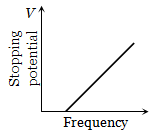
In the graph given below. If the slope is 4.12  V-sec, then value of ‘h’ should be

(a) 6.6  J-sec

(b) 6.6  J-sec

(c) 9.1  J-sec

(d) None of these

Approximate height of ozone layer above the ground is

(a) 60 to 70 km

(b) 59 km to 80 km

(c) 70 km to 100 km

(d) 100 km to 200 km