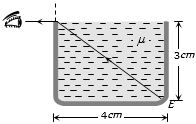
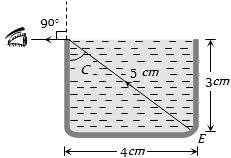
- ✓$1.2$
- B$1.4$
- C$1.6$
- D$1.9$

Generate a complete, print-ready paper with questions like this in minutes — across 16+ boards, with answer keys.
$(i)$ Electrons $(ii)$ Protons $(iii)$ $H{e^{2 + }}$ $(iv)$ Neutrons
The emission at the instant can be

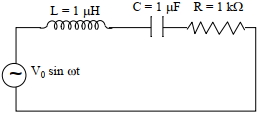
[$A$] The frequency at which the current will be in the phase with the voltage is independent of $R$.
$[B]$ At $\omega \sim 0$ the current flowing through the circuit becomes nearly zero.
[$C$] At $\omega \gg 10^6 \mathrm{rad} . \mathrm{s}^{-1}$, the circuit behave like a capacitor.
[$D$] The current will be in phase with the voltage if $\omega=10^4 \mathrm{rad} . \mathrm{s}^{-1}$
$\overrightarrow{ B }( x , t )=\left[1.2 \times 10^{-7} \sin \left(0.5 \times 10^{3} x +1.5 \times 10^{11} t \right) \hat{ k }\right] T$
The instantaneous electric field $\overrightarrow{ E }$ corresponding to $\overrightarrow{ B }$ is : (speed of light $\left.c=3 \times 10^{8} ms ^{-1}\right)$