When the resistance of $9 \,\Omega$ is connected at the ends of a battery, its potential difference decreases from $40\, volt$ to $30\, volt$. The internal resistance of the battery is ............... $\Omega$
Medium


Download our appand get started for free
Experience the future of education. Simply download our apps or reach out to us for more information. Let's shape the future of learning together!No signup needed.*
Similar Questions
- 1A resistor develops $500\, J$ of thermal energy in $20 \,s$ when a current of $1.5\, A$ is passed through it. If the current is increased from $1.5 \,A$ to $3\, A$ what will be the energy (in $J$) developed in $20\, s$.View Solution
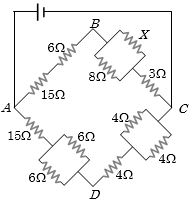
- 2In the figure given the value of $X$ resistance will be, when the $p.d.$ between $B$ and $D$ is zero ................... $ohm$View Solution
- 3The resistance of the series combination of two resistance is $S$. When they are joined in parallel the total resistance is $P$. If $S = nP$, then the minimum possible value of $n$ isView Solution
- 4What amount of heat will be generated in a coil of resistance $R$ due to a charge $q$ passing through it if the current in the coil decreases to zero uniformly during a time interval $\Delta t$View Solution
- 5A current of $10 \,A$ is maintained in a conductor of cross-section $1 \,cm ^2$. If the number density of free electrons be $9 \times 10^{28} \,m ^{-3}$, the drift velocity of free electrons is .......... $m / s$View Solution
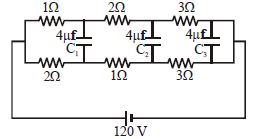
- 6View SolutionIn given circuit
- 7There is a current of $40$ ampere in a wire of ${10^{ - 6}}\,{m^2}$ area of cross-section. If the number of free electron per ${m^3}$ is ${10^{29}}$, then the drift velocity will beView Solution
- 8View SolutionA steady current flows in a metallic conductor of non-uniform cross-section. The quantity/quantities constant along the length of the conductor is/are
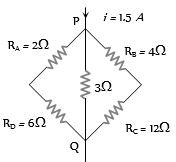
- 9Potential difference between the points $P$ and $Q$ in the electric circuit shown is ................. $V$View Solution
- 10The number density of free electrons in copper is nearly $8 \times 10^{28}\,m ^{-3} . A$ copper wire has its area of cross section $=2 \times 10^{-6}\,m ^2$ and is carrying a current of $3.2\,A$. The drift speed of the electrons is $.....\times 10^{-6}\,ms ^{-1}$.View Solution