Question
When the triangle is revolved about the side $BC$, then the base-radius, height and slant height of the produced cone becomes $AB, BC$ and $AC$ respectively. Therefore, the volume of the produced cone is
Answer

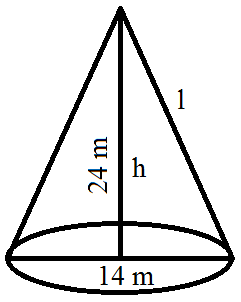
Diameter of base of conical tent $= 14m$
Radius (r) $=\Big(\frac{14}{3}\Big)=7\text{cm}$
Height $(h) = 24 m$

$\therefore$ slant height (l) $=\sqrt{\text{r}^2+\text{h}^2}=\sqrt{7^2+24^2}$
$=\sqrt{49+576}=\sqrt{625}=25\text{m}$
$\therefore$ Surface area $=\pi\text{rl}=\frac{22}{7}\times7\times25\text{m}^2$
$= 550m^2$
Width of cloth used $= 5m$
$\therefore$ Length of cloth used $=\frac{550}{5}=110\text{m}$
Rate of cloth $= ₹ 25$ per metre
$\therefore$ Total cost $= ₹ 110 \times 25 = ₹ 2750$

Need a full question paper?

Generate a complete, print-ready paper with questions like this in minutes — across 16+ boards, with answer keys.

Start Generating Free

Similar questions

Product of the ages of Parth $6$ years ago and $6$ years later is $288$. Find his present age.
A tent of height $77$dm is in the form a right circular cylinder of diameter $36\ m$ and height $44$dm surmounted by a right circular cone. Find the cost of the canvas at Rs. $3.50$ per $m^2$.$\Big[\text{use}\pi=\frac{22}{7}\Big]$
A pole has to be erected at a point on the boundary of a circular park of diameter $13$ meters in such a way that the difference of its distances from two diametrically opposite fixed gates $A$ and $B$ on the boundary is $7$ meters. Is it the possible to do so? If yes, at what distances from the two gates should the pole be erected?
An observer, $1.5\ m$ tall, is $28.5\ m$ away from a a tower $30\ m$ high. Determine the angle elevation of the top of the tower from his eye.
A tent is of the shape of a right circular cylinder upto a height of $3\ m$ and then becomes a right circular cone with a maximum height of $13.5\ m$ above the ground. Calculate the cost of painting the inner side of the tent at the rate of $Rs. 2$ per square metre, if the radius of the base is $14\ m.$
Find the value of a and b for which $\text{x}=-\frac{3}4{}$ and $x = -2$ are the root of the equation $ax^2+ bx - 6 = 0.$
Solve the following quadratic equation:
$\frac{3}{\text{x}+1}-\frac{1}{2}=\frac{2}{\text{3x}-1},$ $\text{x}\neq-1,\ \frac{1}{3}$
A square $ABCD$ is inscribed in a circle of radius r. Find the area of the square.
Determine two consecutive multiples of $3$ whose product is $270.$
Find the ratio in which the y-axis divides the line segment joining the points $(5, -6)$ and $(-1, -4)$. Also, find the coordinates of the point of division.