Question
When three consecutive natural numbers are added, the sum is 66, find the numbers.

Answer

Let first natural number = x
Then second natural number = x + 1
and third number = x + 2
According to the sum,
x + x + 1 + x + 2 = 66
⇒ 3x + 3 = 66
⇒ 3x = 66 - 3 = 63
$\Rightarrow x=\frac{63}{3}=21$
∴ First natural number = 21
second number = 21 + 1 = 22
and third number = 22 + 1 = 23
Hence numbers are 21, 22, 23

Need a full question paper?

Generate a complete, print-ready paper with questions like this in minutes — across 16+ boards, with answer keys.
Start Generating Free

Similar questions

Find the L.C.M. of the following group of numbers, using
  1. the prime factor method and
  2. the common division method
18, 24 and 96
Add the following fractions:
$3 \frac{1}{8}, 5 \frac{5}{12} \text { and } \frac{5}{16}$
A man distributes ₹ 21600 among his three sons $A, B$ and $C$ in the ratio $5: 6: 7$ respectively.
Q.1. A's share is:
(a) ₹ 7200$\quad$(b) ₹ 6000$\quad$(c) ₹ 3600$\quad$(d) ₹ 5400
Q.2. B's share is :
(a) ₹ 7200$\quad$(b) ₹ 6400$\quad$(c) ₹ 5600$\quad$(d) ₹ 4800
Q.3. C's share is :
(a) ₹ 7600$\quad$(b) ₹ 9200$\quad$(c) ₹ 8400$\quad$(d) ₹ 8600
Q.4. If ₹ 600 is added to each of their shares, then the new ratio of their shares would be :
(a) $11: 12: 13$$\quad$(b) $11: 13: 15$$\quad$(c) $13: 15: 17$$\quad$(d) $19: 21: 23$
Evaluate:
$8-\left\{5 \frac{1}{3}-\left(3-2 \frac{1}{2}\right)\right\}$
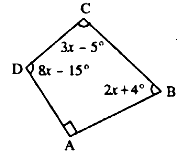
Use the information given in the following figure to find :
(i) x
(ii) ∠B and ∠C
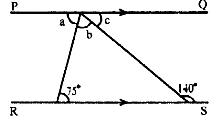
In the following figures, PQ is parallel to RS. Find the angles a, b and c:
Construct traingle ABC, when : AC = 6 cm, ∠A = 60“ and ∠C = 45°. Measure AB and BC.
Find the $L.C.M$. of the following group of numbers, using
  1. the prime factor method and
  2. the common division method
$22, 121$ and $33$
In quadrilateral ABCD, side AB is parallel to side DC. If ∠A : ∠D = 1 : 2 and ∠C : ∠B = 4 : 5
(i) Calculate each angle of the quadrilateral.
(ii) Assign a special name to quadrilateral ABCD
The center of a circle is at point O and its radius is 8 cm. State the position of a point P (point P may lie inside the circle, on the circumference of the circle, or outside the circle), when:
(a) OP = 10.6 cm
(b) OP = 6.8 cm
(c) OP = 8 cm