MCQ
When torque applied on a system is zero, which of the following will be constant?
  • A
    Moment of inertia
  • B
    Angular velocity
  • C
    Kinetic energy
  • Moment of linear momentum

Answer

Correct option: D.
Moment of linear momentum
d
(d)

When the torque acting upon a system is zero, the angular momentum is constant and hence is conserved. This is analogous to the linear counterpart i.e. when the force on the system is zero, the momentum is conserved.

Need a full question paper?

Generate a complete, print-ready paper with questions like this in minutes — across 16+ boards, with answer keys.

Start Generating Free

Similar questions

If the angular momentum of a planet of mass $m$, moving a round the Sun in a circular orbit its $L$, about the center of the Sun, its areal velocity is
A ray of light travels from a medium of refractive index $\mu$ to air. Its angle of incidence in the medium is i, measured from the normal to the boundary, and its angle of deviation is $\delta$. $\delta$ is plotted against $i$ which of the following best represents the resulting curve
Mach List-$I$ with List - $II$ :

List - $I$ List - $II$
$(a)$ Ultraviolet rays $(a)$ Study crystal structure
$(b)$ Microwaves $(b)$ Greenhouse
$(c)$ Infrared waves $(c)$ sterilizing surgical instrument
$(d)$ $x$-rays $(d)$ Radar system

Choose the correct answer from the options given below
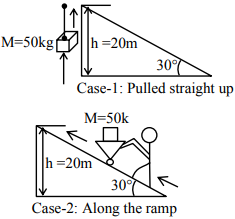
A body of mass 50 kg is lifted to a height of 20 m from the ground in the two different ways as 
shown in the figures. The ratio of work done against the gravity in both the respective cases, 
will be:

Image
The magnifying power of a telescope can be increased by
A conducting sphere $A$ of radius $a$, with charge $Q$, is placed concentrically inside a conducting shell $B$ of radius $b$. $B$ is earthed. $C$ is the common centre of the $A$ and $B$. 
A lead ball moving with a velocity $V$ strikes a wall and stops. If $50\%$ of its energy is converted into heat, then what will be the increase in temperature (Specific heat of lead is $S$)
The kinetic energy of electron and proton is ${10^{ - 32}}J$. Then the relation between their de-Broglie wavelengths is
A body of mass $10 kg$ is projected at an angle of $45^{\circ}$ with the horizontal. The trajectory of the body is observed to pass through a point $(20,10)$. If $T$ is the time of flight, then its momentum vector, at time $t =\frac{ T }{\sqrt{2}}$, is.

$\left[\right.$ Take $\left.g=10 m / s ^{2}\right]$

Let $\vec A = (\hat i + \hat j)$ and $\vec B = (2\hat i - \hat j).$ The magnitude of a coplanar vector $\vec C$ such that $\vec A\cdot \vec C = \vec B\cdot \vec C = \vec A\cdot \vec B$ is given by