MCQ
When two light nuclei are fused together to form a single heavy nucleus this process is called :
  • A
    Nuclear fission
  • Nuclear fusion
  • C
    Radioactivity
  • D
    None of these

Answer

Correct option: B.
Nuclear fusion
B

Need a full question paper?

Generate a complete, print-ready paper with questions like this in minutes — across 16+ boards, with answer keys.
Start Generating Free

Similar questions

When a metal surface is illuminated by light of wavelengths $400\ nm$ and $250\ nm,$ the maximum velocities of the photoelectrons ejected are $v$ and $2v$ respectively. The work function of the metal is $(h =$ Planck’s constant$, c =$ velocity of light in air$)$
Assertion  :   Self-inductance is called the inertia of electricity.
Reason      : Self-inductance is the phenomenon, according to which an opposing induced e.m.f. is produced in a coil as a result of change in current or magnetic flux linked in the coil.(a) If both assertion and reason are true and the reason is the correct explanation of the assertion.(b) If both assertion and reason are true but reason is not the correct explanation of the assertion.(c) If assertion is true but reason is false.(d) If the assertion and reason both are false.


Which of the following electromagnetic waves has the longest wavelength ?
A parallel plate capacitor has a capacity C. The separation between the plates is doubled and a dielectric medium is introduced between the plates. If the capacity now becomes 2C, the dielectric constant of the medium is(a) 2 (b) 1(c) 4  (d) 8
       
Frequency and potential difference of AC sent to homes in India is:
Among the two interfering monochromatic sources A and B; A is ahead of B in phase by 66°. If the observation be taken from point P, such that PB – PA = l/4. Then the phase difference between the waves from A and B reaching P is (a) 156°(b) 140°(c) 136°(d) 126°
       
If a radioactive element is placed in an evacuated chamber, then the rate of radioactive decay will:
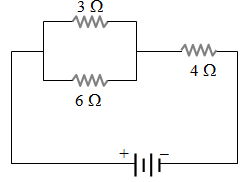
In the figure, current through the $3 \Omega$ resistor is $0.8$ ampere, then potential drop through $4 \Omega$ resistor is
A electron $( q=1.6 \times 10^{-19} \mathrm{C} )$ is moving at right angle to the uniform magnetic field $3.534 \times 10^{-5} \mathrm{~T}.$ The time taken by the electron to complete a circular orbit is
In an unbised p-n junction, holes diffuse from the p-region to n-region because