- ALower than that of the reacting nuclei
- BEqual to that of the reacting nuclei
- CGreater than that of the reacting nuclei
- DEqual to exactly half of either of the reacting nuclei
Explanation:
The binding energy of the product nucleus will be greater than that of the reacting nuclei, because when two light nuclei fuse to form relatively heavier nucleus, energy is released. And the higher the binding energy, the more stable the nucleus is.
Generate a complete, print-ready paper with questions like this in minutes — across 16+ boards, with answer keys.
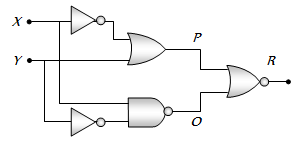
Figure gives a system of logic gates. From the study of truth table it can be found that to produce a high output (1) at R, we must have

| (a) X = 0, Y = 1 | (b) X = 1, Y = 1 | (c) X = 1, Y = 0 | (d) X = 0, Y = 0 |
Consider the following two statements A and B, and identify the correct choice out of given answers
A. Thermo e.m.f. is minimum at neutral temperature of a thermocouple
B. When two junctions made of two different metallic wires are maintained at different temperatures, an electric current is generated in the circuit.
|
(a) A is false and B is true |
(b) A is true and B is false |
|
(c) Both A and B are false |
(d) Both A and B are true |
A light of wavelength 5890 Å falls normally on a thin air film. The minimum thickness of the film such that the film appears dark in reflected light
|
(a) 2.945 |
(b) 3.945 |
(c) 4.95 |
(d) 1.945 |
A pellet carrying charge of 0.5 coulombs is accelerated through a potential of 2,000 volts. It attains a kinetic energy equal to
|
(a) 1000 ergs |
(b) 1000 joules |
(c) 1000 kWh |
(d) 500 ergs |
State which of the following is correct
|
(a) Joule = coulomb × volt |
(b) Joule = coulomb/volt |
|
(c) Joule = volt × ampere |
(d) Joule = volt/ampere |