MCQ
When two light nuclei fuse to form a relatively heavier nucleus, the specific binding energy of the product nucleus is:
  • A
    Lower than that of the reacting nuclei
  • B
    Equal to that of the reacting nuclei
  • Greater than that of the reacting nuclei
  • D
    Equal to exactly half of either of the reacting nuclei
Answer

Correct option: C.
Greater than that of the reacting nuclei

The binding energy of the product nucleus will be greater than that of the reacting nuclei, because when two light nuclei fuse to form relatively heavier nucleus, energy is released. And the higher the binding energy, the more stable the nucleus is.

Need a full question paper?

Generate a complete, print-ready paper with questions like this in minutes — across 16+ boards, with answer keys.

Start Generating Free

Similar questions

The average momentum of a molecule in a sample of an ideal gas depends on:
The inductance of a closed-packed coil of 400 turns is 8 mH. A current of 5 mA is passed through it. The magnetic flux through each turn of the coil is
Half life period of a sample is $15$ years. How long will it take to decay $96.875\%$ of sample .......... $years$
Kinetic energy of the emitted $\alpha-$ particle in the $\alpha -$ decay of ${{}_{88}^{226}Ra}$  will be,  .......... $MeV$

(where ${m_\alpha } = 4.00260\,u$, $m\left( {{}_{88}^{226}Ra} \right)=226.02540\,u$ and $m\left( {{}_{86}^{222}Rn} \right)=222.01750\,u)$

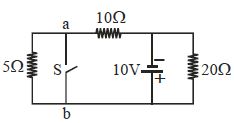
In the circuit shown below, the current that flows from $a$ to $b$ when the switch $S$ is closed ............... $A$
At a specific instant emission of radioactive compound is deflected in a magnetic field. The compound can emit

$(i)$ Electrons              $(ii)$ Protons                 $(iii)$ $H{e^{2 + }}$                  $(iv)$ Neutrons

The emission at the instant can be

The wave-like character was experimentally proved for light by:
A vertical straight conductor carries a current vertically upwards. A point $P$ lies to the east of it at a small distance and another point $Q$ lies to the west at the same distance. The magnetic field at $P$ is
The distance between a proton and electron both having a charge $1.6 \times {10^{ - 19}}\,coulomb$, of a hydrogen atom is ${10^{ - 10}}\,metre$. The value of intensity of electric field produced on electron due to proton will be
The approximate ratio of resistances in the forward and reverse bias of the $PN-$junction diode is