MCQ
When two tuning forks (fork $1$ and fork $2$) are sounded simultaneously, $4$ beats per second are heard. Now, some tape is attached on the prong of the fork $2$. When the tuning forks are sounded again, $6$ beats per second are heard. If the frequency of fork $1$ is $200\, Hz$, then what was the original frequency of fork $2$? .... $Hz$
  • A
    $202$
  • B
    $200$
  • C
    $204$
  • $196$

Answer

Correct option: D.
$196$
d
Frequency of fork $1=200 \mathrm{Hz}=\mathrm{n}_{0}$

No. of beats heard when fork $2$ is sounded

with fork $1=\Delta n=4$

Now we know that if on loading (attaching tape) an unknown fork, the beat frequency increases (from $4$ to $6$ in this case ) then the frequency of the unknown fork $2$ is given by, $\mathrm{n}=\mathrm{n}_{0}-\Delta \mathrm{n}=200-4=196 \mathrm{Hz}$

Need a full question paper?

Generate a complete, print-ready paper with questions like this in minutes — across 16+ boards, with answer keys.

Start Generating Free

Similar questions

The refractive index of prism is $\mu=\sqrt{3}$ and the ratio of the angle of minimum deviation to the angle of prism is one. The value of angle of prism is$. . . . . .^\circ$.
The position-time $(x-t)$ graph for positive acceleration is
A block is lying on an inclined plane which makes $60^°$ with the horizontal. If coefficient of friction between block and plane is $0.25$ and $g = 10\,m/{s^2}$, then acceleration of the block when it moves along the plane will be ........ $m/s^2$
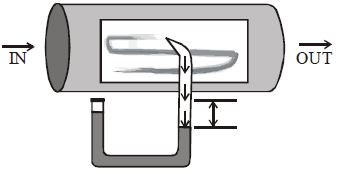
The Pitot tube shown in the figure is used to measure fluid flow velocity in a pipe of cross sectional area $S$. It was invented by a French engineer Henri Pitot in the early $18^{th}$ century. The volume of the gas flowing across the section of the pipe per unit time is (The difference in the liquid columns is $\Delta h,  \rho_0$ and  $\rho$  are the densities of liquid and the gas respectively) :-
$A$ block of mass $m$ moving with a velocity $v_0$ on a smooth horizontal surface strikes and compresses a spring of stiffness $k$ till mass comes to rest as shown in the figure. This phenomenon is observed by two observers:

$A$: standing on the horizontal surface

$B$: standing on the block 

To an observer $A$, the work done by spring force is 

A disc and a sphere of same radius but different masses roll off on two inclined planes of the same altitude and length. Which one of the two objects gets to the bottom of the plane first ?
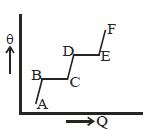
A solid cube having certain fixed melting and boiling points takes heat from some source.The variation  of temperature $\theta$ of the cube with the heat supplied $Q$ is shown in the adjoining graph. The portion $BC$ of the graph represents the conversion of
Masses of three wires of copper are in the ratio of $1 : 3 : 5$ and their lengths are in the ratio of $5:3:1.$ The ratio of their electrical resistances are
An ideal monoatomic gas with pressure $P$, volume $V$ and temperature $T$ is expanded isothermally to a volume $2\, V$ and a final pressure $P_i$. If the same gas is expanded adiabatically to a volume $2\,V$, the final pressure is $P_a$ . The ratio $\frac{{{P_a}}}{{{P_i}}}$ is
A ball is dropped from an elevator moving upward with acceleration ' $a$ ' by a boy standing in it. The acceleration of ball with respect to [Take upward direction positive]