MCQ
When vapour condenses into liquid
  • A
    It absorbs heat
  • It liberates heat
  • C
    Its temperature increases
  • D
    Its temperature decreases

Answer

Correct option: B.
It liberates heat
b
(b) In vapor to liquid phase transition, heat liberates.

Need a full question paper?

Generate a complete, print-ready paper with questions like this in minutes — across 16+ boards, with answer keys.

Start Generating Free

Similar questions

If velocity $[V],$ time $[T]$ and force $[F]$ are chosen as the base quantities, the dimensions of the mass will be
When the current through a solenoid increases at a constant rate, the induced current
While using an electric bulb, the reflection for street lighting should be from
For a gas $\gamma = 7/5.$ The gas may probably be
The acceleration due to gravity on the surface of earth is $g$. If the diameter of earth reduces to half of its original value and mass remains constant, then acceleration due to gravity on the surface of earth would be :
Assuming the nitrogen molecule is moving with $r.m.s.$ velocity at $400\, K$, the de$-$Broglie wavelength of nitrogen molecule is close to$......\mathring {A}$

(Given : nitrogen molecule weight :

$4.64 \times 10^{-26}\, kg ,$ Boltzman constant :

$1.38 \times 10^{-23}\, J / K ,$ Planck constant :

$\left.6.63 \times 10^{-34}\, J . s \right)$
A force is applied to a steel wire ' $A$ ', rigidly clamped at one end. As a result elongation in the wire is $0.2\,mm$. If same force is applied to another steel wire ' $B$ ' of double the length and a diameter $2.4$ times that of the wire ' $A$ ', the elongation in the wire ' $B$ ' will be $............\times 10^{-2}\,mm$ (wires having uniform circular cross sections)
If $v$ is the speed of sound in air then the shortest length of the closed pipe which resonates to a frequency $n$
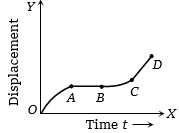
The graph between the displacement $x$ and time $t$ for a particle moving in a straight line is shown in figure. During the interval $OA,\,AB,\,BC$ and $t = 1,\;{v_x} = 0$, the sign of acceleration of the particle at $OA, AB, BC, CD$ is respectively
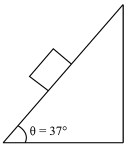
A cubical block of side $‘a’$ and density $‘\rho ’$ slides over a fixed inclined plane with constant velocity $‘v’$. There is a thin film of viscous fluid of thickness $‘t’$ between the plane and the block. Then the coefficient of viscosity of the thin film will be: