Question
When we can consider a charged particle as point electric charge ?

Answer

►When the linear size of charged bodies are much smaller than the distance separating them, the size may be ignored and the charged bodies are treated as point charges.

Need a full question paper?

Generate a complete, print-ready paper with questions like this in minutes — across 16+ boards, with answer keys.
Start Generating Free

Similar questions

Consider a small cube of volume $1mm^3$ at the centre of a circular loop of radius 10cm carrying a current of 4A. Find the magnetic energy stored inside the cube.
Find the intensity at a point on a screen in Young’s double slit experiment where the interfering waves have a path difference of (i) $\lambda/6$, and (ii) $\lambda/2.$
Ultraviolet light is incident on two photosensitive materials having work functions $W_1$ and $W_2(W_1 > W_2)$. In which case will the kinetic energy of the emitted electrons be greater? Why?
A Kundt's tube apparatus has a steel rod of length 1.0m clamped at the centre. It is vibrated in its fundamental mode at a frequency of 2600Hz. The lycopodium powder dispersed in the tube collects into heaps separated by 6.5cm. Calculate the speed of sound in steel and in air.
Why does a phonograph-record attract dust particles just after it is cleaned?
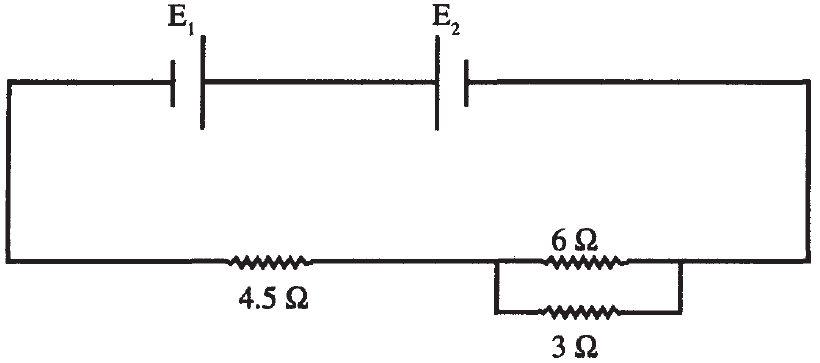
Two cells $E_1$ and $E_2$ in the given circuit diagram have an emf of 5 V and 9 V and internal resistance of 0.3 $\Omega$ and 1.2 $\Omega$ respectively.
Calculate the value of current flowing through the resistance of 3 $\Omega$.
The wavelength of $\text{K}_\alpha$ X-ray of tungsten is 21.3pm. It takes 11.3keV to knock out an electron from the L shell of a tungsten atom. What should be the minimum accelerating voltage across an X-ray tube having tungsten target which allows production of $\text{K}_\alpha$ X-ray?
Explain why at the surface of a charged conductor, electric field is normal to the surface at each point.
A radioactive nucleus A undergoes a series of decay according to following scheme:
$\text{A}\ \xrightarrow{\ \alpha\ }\ \text{A}_1\ \xrightarrow{\ \beta\ }\ \text{A}_2\ \xrightarrow{\ \alpha\ }\ \text{A}_3\ \xrightarrow{\ \text{g}\ }\ \text{A}_4$
The mass number and atomic number of A are 180 and 72 respectively. What are these numbers for $A_4?$
Write the importance of Huygens principle. What are the two assumptions of this theory?