MCQ
When we hear a sound, we can identify its source from
  • A
    Amplitude of sound
  • B
    Intensity of sound
  • C
    Wavelength of sound
  • Overtones present in the sound

Answer

Correct option: D.
Overtones present in the sound
d
(d)The sounds of different source are said to differ in quality. The number of overtones and their relative intensities determines the quality of any musical sound.

Need a full question paper?

Generate a complete, print-ready paper with questions like this in minutes — across 16+ boards, with answer keys.
Start Generating Free

Similar questions

The length of a wire is $1.0\, m$ and the area of cross-section is $1.0 \times {10^{ - 2}}\,c{m^2}$. If the work done for increase in length by $0.2\, cm$ is $0.4\, joule$, then Young's modulus of the material of the wire is
$Assertion$: A rigid disc rolls without slipping on a fixed rough horizontal surface with uniform angular velocity. Then the acceleration of lowest point on the disc is zero.
$Reason$ : For a rigid disc rolling without slipping on a fixed rough horizontal surface, the velocity of the lowest point on the disc is always zero
A projectile is thrown with velocity $u$ making angle $\theta$ with vertical. It just crosses the tops of two poles each of height $h$ after $1\,s$ and $3\,s$, respectively. The maximum height of projectile is ............ $m$
The satellite of mass $m$ revolving in a circular orbit of radius $r$ around the earth has kinetic energy $E$. Then its angular momentum will be
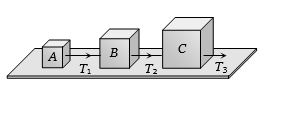
Three blocks $A, B$ and $C $ weighing $1, 8$ and $27\, kg$ respectively are connected as shown in the figure with an inextensible string and are moving on a smooth surface. ${T_3}$ is equal to $36\, N$. Then ${T_2}$ is ........ $N$
The length of the string of a musical instrument is $90 \;cm$ and has a fundamental frequency of $120 \;Hz$. Where (In $cm$) should it be pressed to produce fundamental frequency of $180 \;Hz ?$
Two skaters $P$ and $Q$ are skating towards each other. Skater $P$ throws a ball towards $Q$ every $5 \,s$ such that it always leaves her hand with speed $2 \,ms ^{-1}$ with respect to the ground. Consider two cases:

$(I)$ $P$ runs with speed $1 \,ms ^{-1}$ towards $Q$, while $Q$ remains stationary.

$(II)$ $Q$ runs with speed $1 \,ms ^{-1}$ towards $P$, while $P$ remains stationary.

Note That irrespective of speed of $P$, ball always leaves $P$ s hand with speed $2 \,ms ^{-1}$ with respect to the ground. Ignore gravity. Balls will be received by $Q$.

A body of mass $4\  kg$ collides head-on elastically with another body of mass $2\  kg$ kept at rest in free space. Time of collision is $0.02\  sec$ and average impulse force acted on each bodies is $100\  N$. Find the velocity of the $2\  kg$ body after the impact
The AC voltage across a resistance can be measured using:
Two plates $A$ and $B$ have thermal conductivities $84\,Wm ^{-1}\,K ^{-1}$ and $126\,Wm ^{-1}\,K ^{-1}$ respectively. They have same surface area and same thickness. They are placed in contact along their surfaces. If the temperatures of the outer surfaces of $A$ and $B$ are kept at $100^{\circ}\,C$ and $0{ }^{\circ}\,C$ respectively, then the temperature of the surface of contact in steady state is $..........\,{ }^{\circ} C$.