Question
When we heat an object, it expands. Is work done by the object in this process ? Is heat given to the object equal to the increase in its internal energy?

Answer

When we heat an object, it expands, i.e. its volume increases. Work done by the system, $\Delta\text{W}=\text{P}\Delta\text{V}$ Using the first law of thermodynamics, we get,$\Delta\text{Q}=\Delta\text{U}+\Delta\text{W}$
Since the volume changes, $\Delta\text{W}$ has some non-zero positive value. Thus, heat given to the object is not equal to the increase in the internal energy of the system.

Need a full question paper?

Generate a complete, print-ready paper with questions like this in minutes — across 16+ boards, with answer keys.
Start Generating Free

Similar questions

When a photon is emitted by a hydrogen atom, the photon carries a momentum with it. $(a)$ Calculate the momentum carries by the photon when a hydrogen atom emits light of wavelength $656.3\ nm . (b)$ With what speed does the atom recoil during this transition? Take the mass of the hydrogen atom $=1.67 \times 10^{-27} \mathrm{~kg}. (c)$ Find the kinetic energy of recoil of the atom.
Should the energy of a photon be called its kinetic energy or its internal energy?
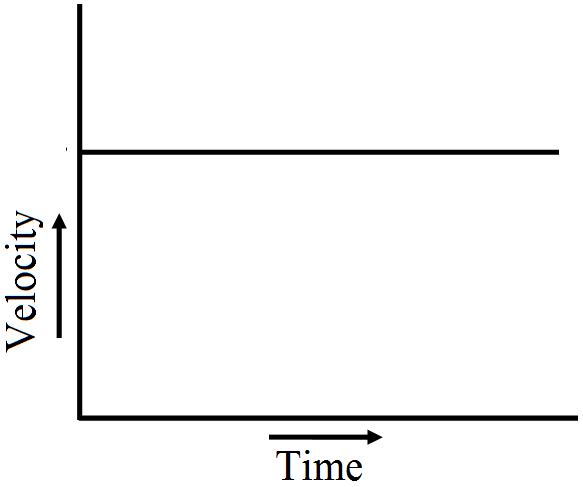
Velocity-time graph of a moving object is shown below. What is the acceleration of the object? Also draw displacement-time graph for the motion of the object.
Two moles of gas A at 27°C are mixed with 3 moles of gas B at 37°C. If both are monoatomic ideal gases, what will be the temperature of the mixture?
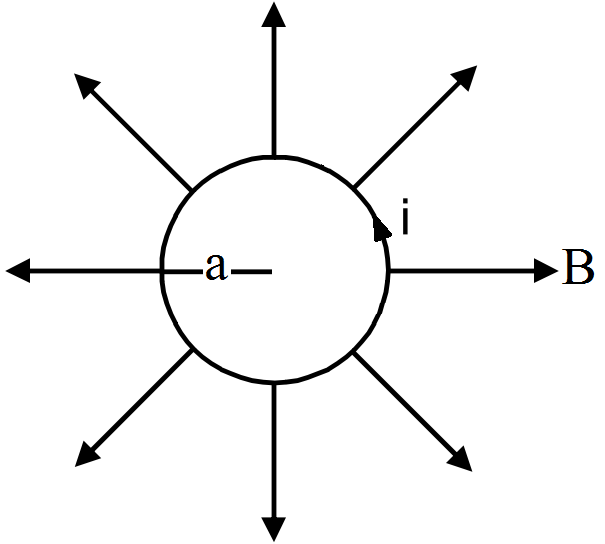
A circular loop of radius a, carrying a current i, is placed in a two-dimensional magnetic field. The centre of the loop coincides with the centre of the field The strength of the magnetic field at the periphery of the loop is B. Find the magnetic force on the wire.
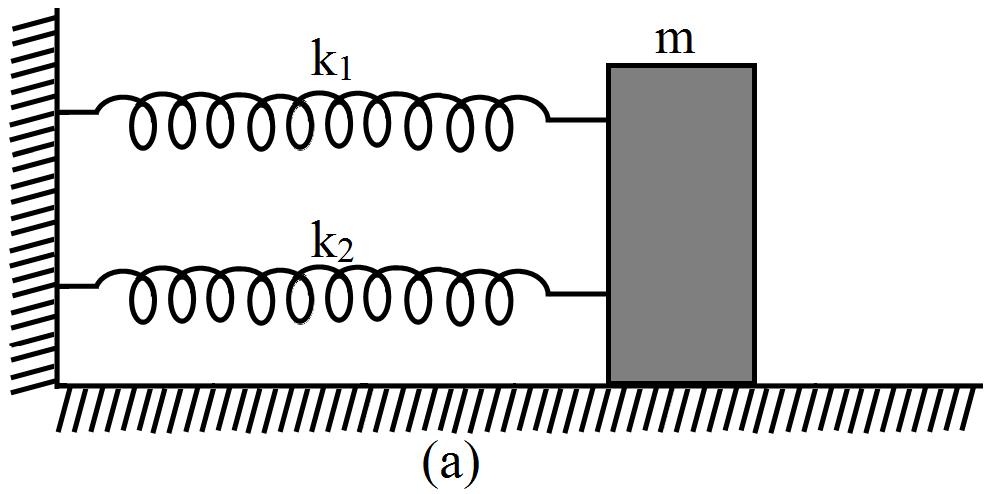
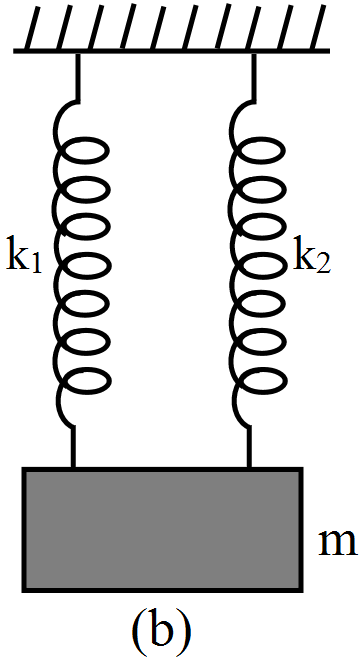
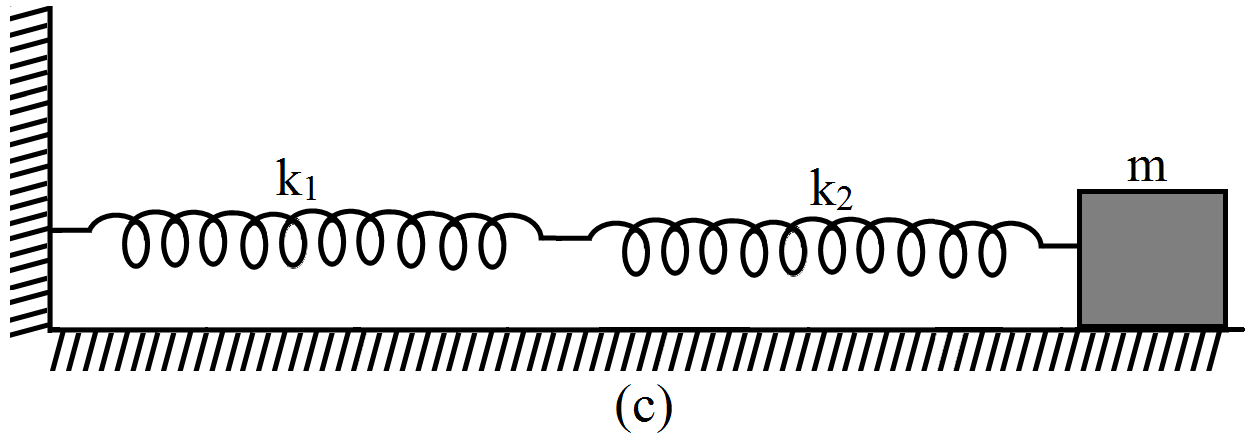
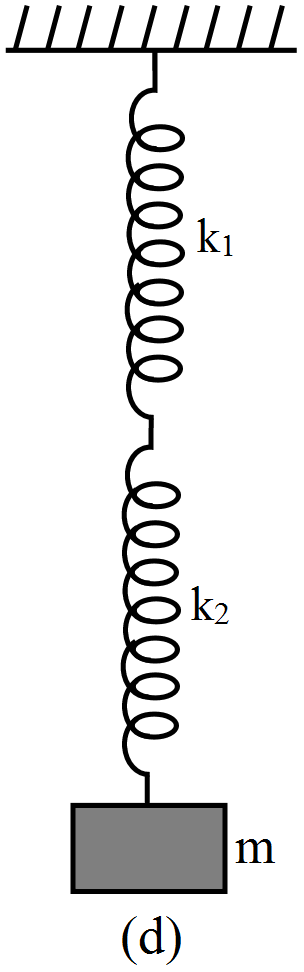
Figure below shows four different spring arrangements. If the mass in each arrangement is displaced from its equilibrium position and released, what is the resulting frequency of vibration in each case? Neglect the mass of the spring. (Fig. (a) and (b) represent an arrangement of springs in parallel, and (c) and (d) represent springs in series)


Two identically charged particles are fastened to the two ends of a spring of spring constant $100 \mathrm{Nm}^{-1}$ and natural length 10 cm . The system rests on a smooth horizontal table. If the charge on each particle is $2.0 \times 10^{-8} \mathrm{C}$, find the extension in the length of the spring. Assume that the extension is small as compared to the natural length. Justify this assumption after you solve the problem.
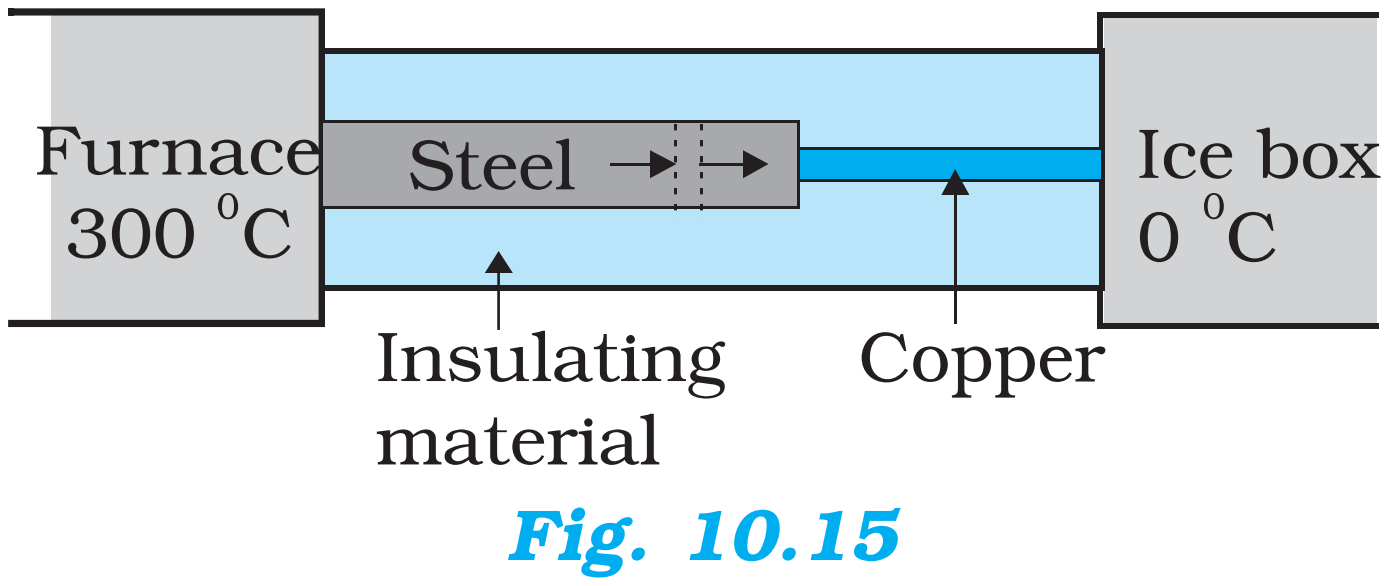
What is the temperature of the steel-copper junction in the steady state of the system shown in Fig. 10.15. Length of the steel rod $=15.0 cm$, length of the copper rod $=10.0 cm$, temperature of the furnace $=300^{\circ} C$, temperature of the other end $=0{ }^{\circ} C$. The area of cross section of the steel rod is twice that of the copper rod. (Thermal conductivity of steel $=50.2 J s ^{-1} m ^{-1} K ^{-1}$; and of copper $\left.=385 J s ^{-1} m ^{-1} K ^{-1}\right)$.
Image
What is meant by monochromatic emittance, emissive power, emissivity and monochromatic absorbtance.
Explain the conservation of mechanical energy in the oscillation of a body suspended from a spring.