Question
When we stir a liquid vigorously, it becomes warm. Is it a reversible process?

Answer

When we stir a liquid vigorously, we do work on it due to which its temperature rises and it becomes warm. To bring back the liquid to the initial temperature, heat needs to be extracted from it. But it is an irreversible process that cannot be brought back to the initial state by stirring the liquid again in the opposite direction.

Need a full question paper?

Generate a complete, print-ready paper with questions like this in minutes — across 16+ boards, with answer keys.
Start Generating Free

Similar questions

An ideal gas $\Big(\frac{\text{C}_\text{P}}{\text{C}_\text{V}}=\gamma\Big)$ is taken through a process in which the pressure and the volume vary as $p = aV^b$. Find the value of b for which the specific heat capacity in the process is zero.
How electromagnetic waves are produced? What is the source of the energy accompanied by any propagating electromagnetic wave?
(i) In far switches of household electrical appliances
(ii) In medical diagnosis
Can we find the mass of a photon by the definition p = mv?
Two concentric circular coils, one of small radius $r_1$ and the other of large radius $r_2$, such that $r_1 \ll r_2$, are placed co-axially with centres coinciding. Obtain the mutual inductance of the arrangement.
An ideal gas expands from $100cm^3$ to $200cm^3$ at a constant pressure of $2.0 \times 10^5$ Pa when 50J of heat is supplied to it. Calculate,
  1. The change in internal energy of the gas.
  2. The number of moles in the gas if the initial temperature is 300K.
  3. The molar heat capacity $C_p$ at constant pressure.
  4. The molar heat capacity $C_v$ at constant volume.
In a photodiode, the conductivity increases when the material is exposed to light. It is found that the conductivity changes only if the wavelength is less than 620nm. What is the band gap?
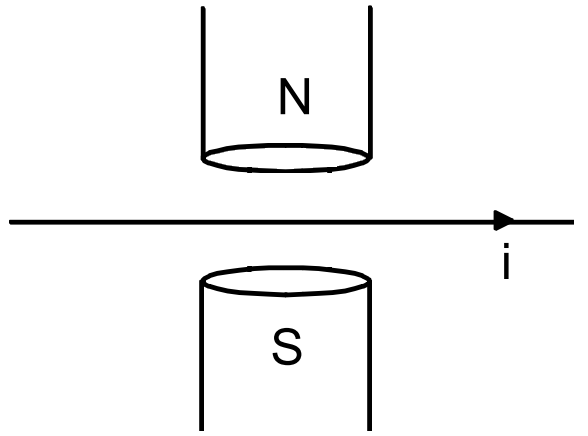
A magnetic field of strength 1.0T is produced by a strong electromagnet in a cylindrical region of radius 4.0cm, as shown in the figure. A wire, carrying a current of 2.0A, is placed perpendicular to and intersecting the axis of the cylindrical region. Find the magnitude of the force acting on the wire.
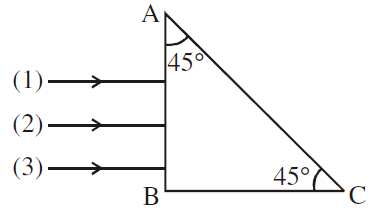
Three rays (1, 2, 3) of different colours fall normally on one of the sides of an isosceles right angled prism as shown. The refractive index of prism for these rays is 1.39, 1.47 and 1.52 respectively. Find which of these rays get internally reflected and which get only refracted from AC. Trace the paths of rays. Justify your answer with the help of necessary calculations.
Suppose we have 12 protons and 12 neutrons. We can assemble them to form either a :uMg nucleus or two 12C nuclei. In which of the two cases more energy will be liberated?
A mixture contains 1 mole of helium $(C_p = 2.5R, C_v = 1.5R)$ and 1 mole of hydrogen $(C_p= 3.5R, C_v= 2.5R).$ Calculate the values of $C_p, C_v$ and $\gamma$ for the mixture.