Question
When white light enters a prism, it gets split into its constituent colours. This is due to

Answer

(b)  For different colours $\mu$ changes so deviation of different colour is also different.

Need a full question paper?

Generate a complete, print-ready paper with questions like this in minutes — across 16+ boards, with answer keys.
Start Generating Free

Similar questions

The resultant of two rectangular simple harmonic motions of the same frequency and unequal amplitudes but differing in phase by $\frac{\pi }{2}$ is
A light ray traveling in glass medium is incident on glass-air interface at an angle of incidence $\theta$. The reflected $( R )$ and transmitted ( $T$ ) intensities, both as function of $\theta$, are plotted. The correct sketch is
The equation of motion of a particle is $\frac{{{d^2}y}}{{d{t^2}}} + Ky = 0$, where $K$ is positive constant. The time period of the motion is given by
What is the change in temperature on Fahrenheit scale and Kelvin scale, if an iron piece is heated from $30\ ^oC$ to $90\ ^oC$?
A newly discovered planet has a density eight times the density of the earth and a radius twice the radius of the earth. The time taken by $2\, kg$ mass to fall freely through a distance $S$ near the surface of the earth is $1$ second. Then the time taken for a $4\, kg$ mass to fall freely through the same distance $S$ near the surface of the new planet is ....... $\sec$.
The frequency for which a $5\,\mu F$ capacitor has a reactance of $\frac{1}{{1000}}$ ohm is given by
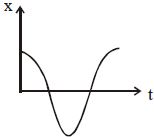
Dispacement time graph of a particle executing $SHM$ is as shown in the figure. Corresponding graph between $PE$ and time is
Two polaroids are placed in the path of unpolarized beam of intensity ${I_0}$ such that no light is emitted from the second polaroid. If a third polaroid whose polarization axis makes an angle $\theta$ with the polarization axis of first polaroid, is placed between these polaroids then the intensity of light emerging from the last polaroid will be
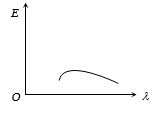
The energy distribution $E$ with the wavelength $(\lambda )$ for the black body radiation at temperature $T\;Kelvin$is shown in the figure. As the temperature is increased the maxima will
Match List $I$ with List $II$

List $I$ List $II$
$A$ Spring constant $I$ $(T ^{-1})$
$B$ Angular speed $II$ $(MT ^{-2})$
$C$ Angular momentum $III$ $(ML ^2)$
$D$ Moment of Inertia $IV$ $(ML ^2 T ^{-1})$

Choose the correct answer from the options given below