MCQ
When yellow light is incident on a surface, no electrons are emitted while green light can emit. If red light is incident on the surface, then
  • No electrons are emitted
  • B
    Photons are emitted
  • C
    Electrons of higher energy are emitted
  • D
    Electrons of lower energy are emitted

Answer

Correct option: A.
No electrons are emitted
a
(a) ${\lambda _r} > {\lambda _y} > {\lambda _g}$. Here threshold wavelength $ < {\lambda _y}$.

Need a full question paper?

Generate a complete, print-ready paper with questions like this in minutes — across 16+ boards, with answer keys.

Start Generating Free

Similar questions

The electric field at the origin is along the positive $x-$axis. A small circle is drawn with the centre at the origin cutting the axes at points $A, B, C$ and $D$ having coordinates $(a, 0), (0, a), (-a, 0), (0, -a)$ respectively. Out of the points on the periphery of the circle, the potential is minimum at.
Electron in hydrogen atom first jumps from third excited state to second excited state and then from second excited to the first excited state. The ratio of the  wavelengths $\lambda_1 :\lambda_2$ emitted in the two cases is
Two parallel large thin metal sheets have equal surface charge densities $\left(\sigma=26.4 \times 10^{-12} C / m ^{2}\right)$ of same signs. The electric field between these sheet is
For continuous $X-$ rays produced wavelength is
An electron from various excited states of hydrogen atom emit radiation to come to the ground state. Let $\lambda_v, \lambda_g$ be the de Broglie wavelength of the electron in the $n^{th}$ state and the ground state respectively. Let $\Lambda_n$ be the wavelength of the emitted photon in the transition from the $n^{th}$ state to the ground state. For large $n, (A, B $ are constants)
Value of potential at a point due to a point charge is
Substance on the choroid is
The image of an illuminated square is obtained on a screen with the help of a converging lens. The distance of the square from the lens is $40\,cm.$ The area of the image is $9\,times$ that of the square. The focal length of the lens is........$cm$
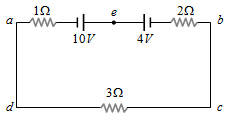
The magnitude and direction of the current in the circuit shown will be

Two spherical conductors B and C having equal radii and carrying equal charges in them repel each other with a force F when kept apart at some distance. A third spherical conductor having same radius as that of B but uncharged is brought in contact with B, then brought in contact with C and finally removed away from both. The new force of repulsion between B and C is