MCQ
Whether a reaction is endothermic or exothermic can be indicated by:
- AEnthalpy change.
- BEntropy change.
- CActivation energy.
- DSpecific heat capacity.
Explanation:
Whether a reaction is endothermic or exothermic can be indicated by enthalpy change.
Enthalpy change is the difference in the enthalpy of products and the enthalpy of reactants.
A positive value of enthalpy change indicates endothermic reaction as the enthalpy of products is more than the enthalpy of reactants.
A negative value of enthalpy change indicates exothermic reaction as the enthalpy of products is less than the enthalpy of reactants.
Generate a complete, print-ready paper with questions like this in minutes — across 16+ boards, with answer keys.
${N_2}\left( g \right) + 3{H_2}\left( g \right) \rightleftharpoons \,2N{H_3}\left( g \right)$
On addition of an inert gas at constant pressure & constant temperature which of the following change is $NOT$ observed
$(A)$ The acidity of compound $I$ is due to delocalization in the conjugate base.
$(B)$ The conjugate base of compound IV is aromatic.
$(C)$ Compound II becomes more acidic, when it has a $- NO _2$ substituent.
$(D)$ The acidity of compounds follows the order $I > IV > V > II > III$.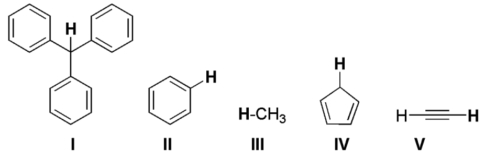
Product in above reaction is