MCQ
Which acid is strongest or Which is most acidic
  • A
    $C{l_2}CH.COOH$
  • B
    $ClC{H_2}COOH$
  • C
    $C{H_3}COOH$
  • $C{l_3}C.COOH$

Answer

Correct option: D.
$C{l_3}C.COOH$
d
(d)Presence of $-I$ effect chlorine atom increases the acidic nature by withdrawing electrons

$\mathop {C{l_3}CCOOH}\limits_{trichloro{\mkern 1mu} \,\,acetic\,\,\,acid(Most{\mkern 1mu} \,\,acidic)}  > $ $\mathop {C{l_2}CHCOOH}\limits_{dichloro\,\,{\kern 1pt} acetic\,{\kern 1pt} acid}  > $ $Cl - C{H_2} - COOH > $ $C{H_3}COOH$

Need a full question paper?

Generate a complete, print-ready paper with questions like this in minutes — across 16+ boards, with answer keys.

Start Generating Free

Similar questions

Which of the following are isoelectronic and isostructural $NO_3^ - ,\,CO_3^{2 - },\,ClO_3^ - ,\,S{O_3}$
In the gaseous equilibrium ${H_2}{X_2} + $ heat  $\rightleftharpoons$  $2HX$, the formation of $HX$ will be favoured by
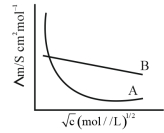
Following figure shows dependence of molar conductance of two electrolytes on concentration. $\Lambda \stackrel{0}{ m }$ is the limiting molar conductivity.The number of Incorrect statement(s) from the following is $...........$

$(A)$ $\Lambda \stackrel{0}{ m }$ for electrolyte $A$ is obtained by extrapolation

$(B)$ For electrolyte B, vx $\Lambda m$ vs $\sqrt{ c }$ graph is a straight line with intercept equal to $\Lambda \stackrel{0}{ m }$

$(C)$ At infinite dilution, the value of degree of dissociation approach zero for electrolyte $B$.

$(D)$ $\Lambda \stackrel{0}{ m }$ for any electrolyte $A$ or $B$ can be calculated using $\lambda^{\circ}$ for individual ions.
The correct values of ionization enthalpies (in $kJ\, mol^{-1}$ ) of $Si, P, Cl$ and $S$ respectively are
Compound $A$ gives $D-$Galactose and $D-$Glucose on hydrolysis. The compound $A$ is:
Identify the product $(P)$ in the following reaction:
Which of the following does not decolourise bromine solution in carbon disulphide
The appropriate naming for the second step in the haloform reaction is:
Identify $Z$ in the sequence of reactions : 

$CH_3 CH_2 CH=CH_2  \xrightarrow{{HBr/{H_2}{o_2}}}\,Y\,\xrightarrow{{{C_2}{H_5}ONa}}Z$

Photochemical chlorination of alkane is initiated by a process of