MCQ
Which acid is strongest or Which is most acidic
  • A
    $C{l_2}CH.COOH$
  • B
    $ClC{H_2}COOH$
  • C
    $C{H_3}COOH$
  • $C{l_3}C.COOH$

Answer

Correct option: D.
$C{l_3}C.COOH$
d
(d)Presence of $-I$ effect chlorine atom increases the acidic nature by withdrawing electrons

$\mathop {C{l_3}CCOOH}\limits_{trichloro{\mkern 1mu} \,\,acetic\,\,\,acid(Most{\mkern 1mu} \,\,acidic)}  > $ $\mathop {C{l_2}CHCOOH}\limits_{dichloro\,\,{\kern 1pt} acetic\,{\kern 1pt} acid}  > $ $Cl - C{H_2} - COOH > $ $C{H_3}COOH$

Need a full question paper?

Generate a complete, print-ready paper with questions like this in minutes — across 16+ boards, with answer keys.

Start Generating Free

Similar questions

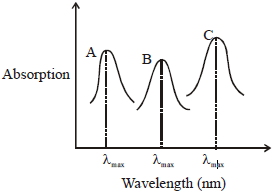
Simplified absorption spectra of three complexes $((i),$$( ii)$ and $( iii ))$ of $M ^{ n +}$ ion are provided below; their $\lambda_{\max }$ values are marked as $A, B$ and $C$ respectively. The correct match between the complexes and their $\lambda_{\max }$ values is

$(i)$ $\left[ M ( NCS )_{6}\right]^{(-6+ n )}$

$(ii)$ $\left[ MF _{6}\right]^{(-6+ n )}$

$(iii)$ $\left[ M \left( NH _{3}\right)_{6}\right]^{ n ^{+}}$
The mass of a substance liberated when a charge '$q$' flows through an electrolyte is proportional to
Which one of the following ions is colourless
Which one of the following compound will give Saytzeff alkene as a major product in elimination reaction?
In a linear tetrapeptide (Constituted with different amino acids), (number of amino acids) - (number of peptide bonds) is
What will be the equivalent weight of $K _2 Cr _2 O _7$ is molecular weight $= M$ ?
Which one is true for ATP?
Nitrogen form $N_2$, but phosphorous form $P_2$, but it convert into $P_4$, at a instant the reason is
Given below are two statements :

Statement $I$ : The rate law for the reaction $A+B \rightarrow C$ is rate $(r)=k[A]^2[B]$. When the concentration of both $\mathrm{A}$ and $\mathrm{B}$ is doubled, the reaction rate is increased " $\mathrm{x}$ " times.

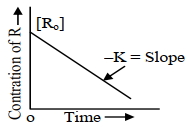
Statement $II$ :

(Image)

The figure is showing "the variation in concentration against time plot" for a $"y"$ order reaction. The value of $x+y$ is . . . . . . 
When a substance is dissolved in a solvent the vapour pressure of the solvent is decreased. This results in