Question
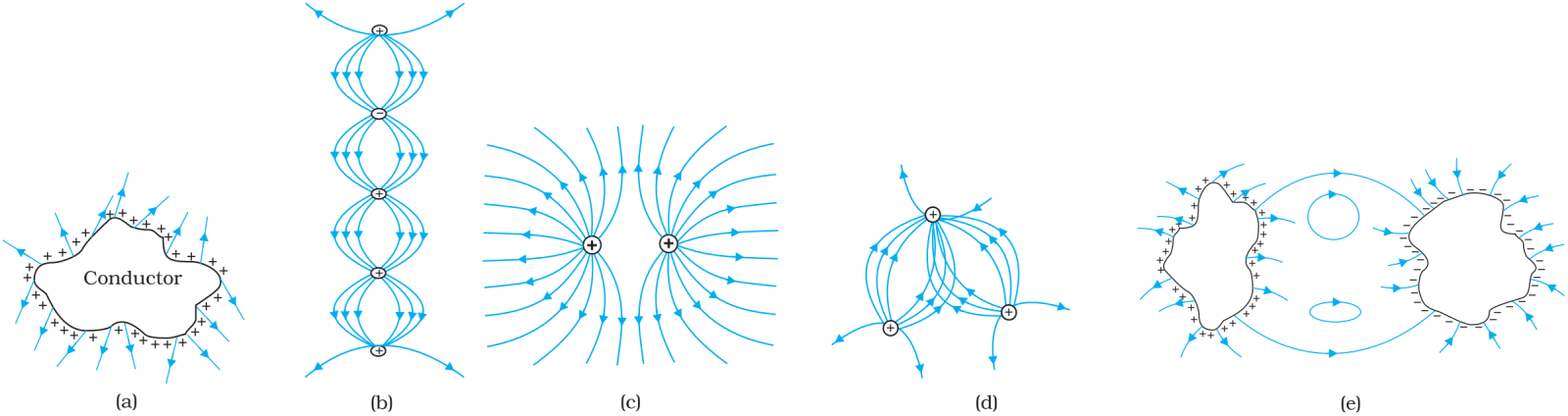
Which among the curves shown in figure cannot possibly represent electrostatic field lines?
Answer

  1. Field lines are wrongly drawn because electric field lines must be normal to the surface of the conductor at each point.
  2. Field lines are wrongly drawn because field lines cannot start from a negative charge.
  3. Field lines are correctly drawn, because they are originating from a positive charge.
  4. Field lines are wrongly drawn as the field lines cannot intersect.
  5. Field lines are wrongly drawn because they cannot form closed loops.

Need a full question paper?

Generate a complete, print-ready paper with questions like this in minutes — across 16+ boards, with answer keys.

Start Generating Free

Similar questions

A straight, long wire carries a current of 20A. Another wire carrying equal current is placed parallel to it. If the. force acting on a length of 10cm of the second wire is 2 ×10⁻⁵N, what is the separation between them?
Give reasons for the following:
  1. The Zener diode is fabricated by heavily doping both the p and n sides of the junction.
  2. A photodiode, when used as a detector of optical signals is operated under reverse bias.
  3. The band gap of the semiconductor used for fabrication of visible LED’s must at least be 1.8eV.
A gas cylinder has walls that can bear a maximum pressure of 1.0 × 10⁶Pa. It contains a gas at 8.0 × 10⁵Pa and 300K. The cylinder is steadily heated. Neglecting any change in the volume, calculate the temperature at which the cylinder will break.
In a Geiger-Marsden experiment, what is the distance of closest approach to the nucleus of a $7.7 MeV \alpha$-particle before it comes momentarily to rest and reverse its direction?
Current of 4 A is flowing in a straight wire AB. A proton $P$ is travelling parallel to the wire in the opposite direction of current with a speed of $4 \times 10^6$ $m / s$ at a distance of 0.2 m from the wire as shown in the diagram. Calculate the magnitude of force applied on the proton and also tells its direction.
Electromotive forces of two cells are $E_1$ and $E _2$ and their internal resistances are $r_1$ and $r_2$. Find equivalent electromotive force and equivalent internal resistance on joining them in series.
Describe principle and construction of AC generator with figure and discuss its working.
  1. Draw a graph showing variation of photocurrent with anode potential for a particular intensity of incident radiation. Mark saturation current and stopping potential.
  2. By how much would the stopping potential for a given photosensitive surface go up if the frequency of the incidentradiations were to be increased from $4\times10^{15}\text{ }\text{Hz}\text{ }\text{to}8\text{ }\times10^{15}\text{ }\text{Hz}$?
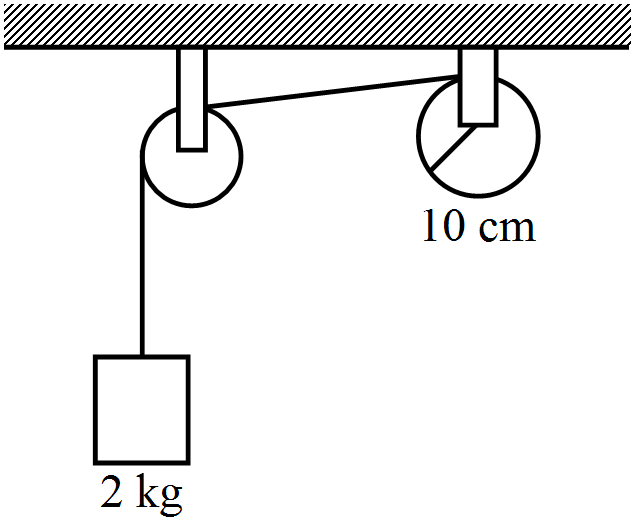
A string is wrapped on a wheel of moment of inertia 0.20kg-m2 and radius 10cm and goes through a light pulley to support a block of mass 2.0kg as shown in figure. Find the acceleration of the block.

  1. Monochromatic light of wavelength 589 nm is incident from air on a water surface. If $\mu$ for water is 1.33, find the wavelength, frequency and speed of the refracted light.
  2. A double convex lens is made of a glass of refractive index 1.55, with both faces of the same radius of curvature. Find the radius of curvature required, if the focal length is 20 cm.