MCQ
Which among the following is the strongest Bronsted base ?
- A
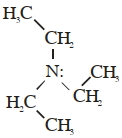
- B
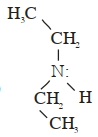
- C
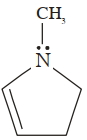
- ✓
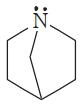
Generate a complete, print-ready paper with questions like this in minutes — across 16+ boards, with answer keys.
The order of decreasing reactivities of these alcohols towards substitution with $HBr$ is
$A_{2(g)} + B_{2(g)} \rightleftharpoons 2AB_{(g)}$
At equilibrium, the concentration of $A_2= 3.0 \times 10^{-3} \, M,$ of $B_2= 4.2 \times 10^{-3} \, M,$ of $AB= 2.8 \times 10^{-3} \, M,$
If the reaction takes place in a sealed vessel at $527^o C,$ then the value of $K_c$ will be
$2 H _2( g )+2 NO ( g ) \rightarrow N _2( g )+2 H _2 O ( g )$
which following the mechanism given below:
$2 NO ( g ) \underset{ k _{-1}}{\stackrel{ k _1}{\rightleftharpoons}} N _2 O _2( g )$
$N _2 O _2( g )+ H _2( g ) \stackrel{ k _2}{\rightleftharpoons} N _2 O ( g )+ H _2 O ( g )$
$N _2 O ( g )+ H _2( g ) \stackrel{ k _3}{\rightleftharpoons} N _2( g )+ H _2 O ( g )$
(fast equilibrium)
(slow reaction)
(fast reaction)
The order of the reaction is
| $I.E.\, (kJ \,mol^{-1})$ | $I.E.\, (kJ\, mol^{-1})$ |
| $A_{(g)} \to A^+_{(g)}+e^-,$ $A_1$ | $B_{(g)} \to B^{+}_{(g)}+e^-,$ $B_1$ |
| $B^+_{(g)} \to B^{2+}_{(g)}+e^-,$ $B_2$ | $C_{(g)} \to C^{+}_{(g)}+e^-,$ $C_1$ |
| $C^+_{(g)} \to C^{2+}_{(g)}+e^-,$ $C_2$ | $C^{2+}_{(g)} \to C^{3+}_{(g)}+e^-,$ $C_3$ |
If monovalent positive ion of $A,$ divalent positive ion of $B$ and trivalent positive ion of $C$ have zero electron. Then incorrect order of corresponding $I.E.$ is