Question
Which aqueous solution has higher concentration-1 molar or 1 molal solution of the same solute? Give reason.

Answer

Here density determines the relative concentrations of the solutions.Case I:
When density of solvent is 1g/ mL: In aqueous solution, density of water is normally taken as 1. This means that 1m solution has 1 mole of the solute dissolved in 1000g or 1000mL of the solvent. At the same time 1M solution contains 1 mole of the solute in 1000mL solution, which is the volume of both the solute and solvent present in the solution. This clearly shows that the solvent present in 1M solution is less as compared to 1m solution. Therefore, 1M solution is more concentrated than 1m solution.
Case II:
When density of the solvent is less than 1g/ mL: This means that the volume of solvent (mass/ density) will be more as compared to its mass. Thus, 1M solution will be less concentrated than 1m solution.
Case III:
When density of the solvent is more than 1g/ mL: This means that the volume of solvent will be less than its mass. Under these circumstances, 1M solution will be more concentrated than 1m solution.
Need a full question paper?

Generate a complete, print-ready paper with questions like this in minutes — across 16+ boards, with answer keys.

Start Generating Free

Similar questions

Answer the following question:
Give chemical tests to distinguish between:
  1. Acetaldehyde and benzaldehyde.
  2. Propanone and propanol.
Calculate the amount of benzoic acid $(C_6H_5COOH)$ required for preparing $250\ mL$ of $0.15\ M$ solution in methanol.
Boiling point of water at $750\ mm$ Hg is $99.63^\circ C.$ How much sucrose is to be added to $500\ g$ of water such that it boils at $100^\circ C.$
Complete the following giving the structures of major organic products.
$(\text{CH}_3)_3-\text{C}-\text{CH}_2-\text{Br}\xrightarrow[\Delta]{\text{C}_2\text{H}_5\text{ONa}/\text{C}_2\text{H}_5\text{OH}}\ ........$
Draw the structure of the following:
(i) $ H_{3}PO_{4} $, (ii) $ H_{3}PO_{3} $, (iii) $ H_{3}PO_{2} $, (iv) $ H_{4}P_{2}O_{7} $, (v) $ (HPO_{3})_{3} $
earrange the compounds of each of the following sets in order of reactivity towards $S_N2$ displacement:
  1. $2-$Bromo$-2-$methylbutane, $1-$Bromopentane, $2-$Bromopentane.
  2. $1-$Bromo$-3-$methylbutane, $2-$Bromo$-2-$methylbutane, $3-$Bromo$-2-$methylbutane.
  3. $1-$Bromobutane, $1-$Bromo$-2, 2-$dimethylpropane, $1-$Bromo$-2-$methylbutane.
What is essentially the difference between $\alpha\ -$ glucose and $\beta\ -$ glucose? What is meant by pyranose structure of glucose?
Give simple chemical terts to distinguish between the pair of compound :
Propanal and Propanone
A $10\%$ solution $($by mass$)$ of sucrose in water has freezing point of $269.15 K.$ Calculate the freezing point of $10\%$ glucose in water if freezing point of pure water is $273.15 K.$
Given: $($Molar mass of sucrose $= 342\ g\ mol^{–1})$
$($Molar mass of glucose $= 180\ g\ mol^{–1})$
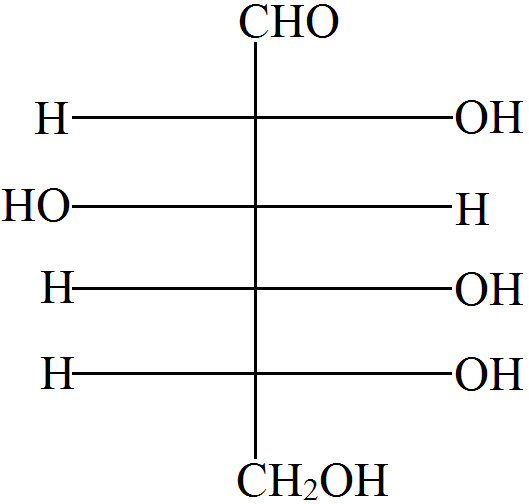
The Fischer projection of D-Glucose is given alongside.
Give the Fischer projection of L-Glucose.