Question
Which aqueous solution has higher concentration-1 molar or 1 molal solution of the same solute? Give reason.

Answer

Here density determines the relative concentrations of the solutions.

Case I:

When density of solvent is 1g/ mL: In aqueous solution, density of water is normally taken as 1. This means that 1m solution has 1 mole of the solute dissolved in 1000g or 1000mL of the solvent. At the same time 1M solution contains 1 mole of the solute in 1000mL solution, which is the volume of both the solute and solvent present in the solution. This clearly shows that the solvent present in 1M solution is less as compared to 1m solution. Therefore, 1M solution is more concentrated than 1m solution.

Case II:

When density of the solvent is less than 1g/ mL: This means that the volume of solvent (mass/ density) will be more as compared to its mass. Thus, 1M solution will be less concentrated than 1m solution.

Case III:

When density of the solvent is more than 1g/ mL: This means that the volume of solvent will be less than its mass. Under these circumstances, 1M solution will be more concentrated than 1m solution.

Need a full question paper?

Generate a complete, print-ready paper with questions like this in minutes — across 16+ boards, with answer keys.
Start Generating Free

Similar questions

Rearrange the compounds of each of the following sets in order of reactivity towards SN2 displacement:
  1. 2-Bromo-2-methylbutane, 1-Bromopentane, 2-Bromopentane.
  2. 1-Bromo-3-methylbutane, 2-Bromo-2-methylbutane, 3-Bromo-2-methylbutane.
  3. 1-Bromobutane, 1-Bromo-2, 2-dimethylpropane, 1-Bromo-2-methylbutane.
Answer the following questions:
An optically active compound having molecular formula C7H15Br reacts with aqueous KOH to give a racemic mixture of products. Write the mechanism involved in this reaction.
Boiling point of water at 750 mm Hg is 99.63°C. How much sucrose is to be added to 500 g of water such that it boils at 100°C.
Give reactions taking place at the two electrodes if these are made up of Ag.
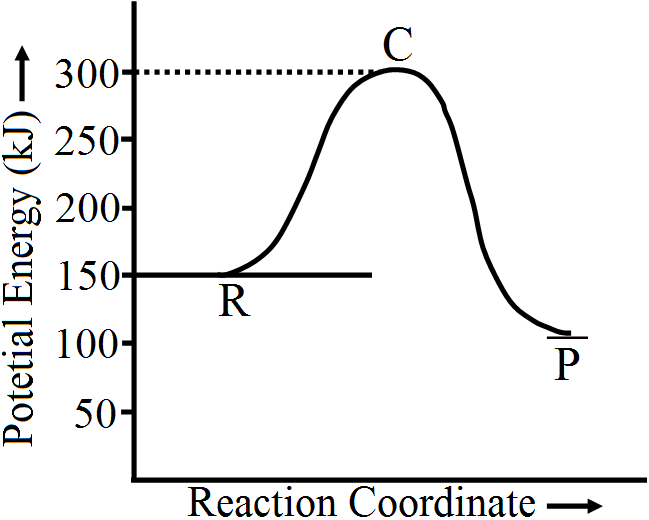
Answer the following questions on the basis of the given plot of potential energy vs reaction coordinate:

  1. What is the threshold energy for the reaction?
  2. What is the activation energy for forward reaction?
  3. What is the activation energy for backward reaction?
  4. What is enthalpy change for the forward reaction?

Explain aldol condensation with suitable example. ### Write a short note: Aldol condensation.
Explain Rate law and Rate constant with an example.
What happens when :
(i) Acetic acid reacts with chlorine in the presence of red phosphorus?
(ii) Silver acetate reacts with bromine in the presence of inert solvent $\left( CCl _4\right)$ ?
A 4% solution(w/ w) of sucrose (M = 342g mol-1) in water has a freezing point of 271.15K. Calculate the freezing point of 5% glucose (M = 180g mol-1) in water.
(Given: Freezing point of pure water = 273.15 K)
Compound with molecular formula $C _4 H _8 O$ reacts with hydrazine and gives hydrazone. It forms iodoform by the reaction with iodine and NaOH but does not react with Fehling solution. Give the structure of this compound and required equations.