MCQ
Which are the dissimilarities between $CO$ and $PF_3$ 
  • A
    $PF_3$ is a $\sigma-$ donor, $\pi-$ acceptor while $CO$ is $\pi-$ donor, $\pi-$ acceptor towards a metal/ metal ion in a complex
  • B
    $CO$ is toxic while $PF_3$ is nontoxic
  • C
    $CO$ is odourless while $PF_3$ has pungent odour
  • $CO$ acepts back donation into its $\pi^*$ orbital while $PF_3$ accepts back donation into its $3d$ orbital in a complex
Answer

Correct option: D.
$CO$ acepts back donation into its $\pi^*$ orbital while $PF_3$ accepts back donation into its $3d$ orbital in a complex
d

Need a full question paper?

Generate a complete, print-ready paper with questions like this in minutes — across 16+ boards, with answer keys.

Start Generating Free

Similar questions

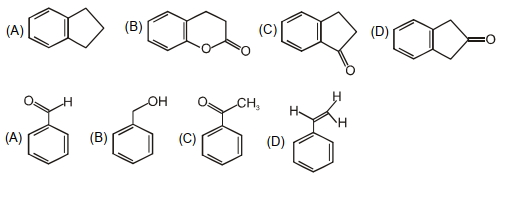
In the following reactions sequence, the compound $J$ is an intermediate.
$I \frac{\left(CH_3 CO\right)_2 O}{CH_3 COONa} J \xrightarrow[\text { (ii) } SOCl]{\text { (i) } H_2, Pd / C} K$
$(ii)$ anhyd. $AlCl _3$
$J \left( C _9 H _8 O _2\right)$ gives effervescence on treatment with $NaHCO _3$ and positive Baeyer's test
$1.$ The compound $K$ is
mcq $Image$
$2.$ The compound $I$ is
mcq $Image$
Give the answer question $1$ and $2.$
The reagents with which glucose does not react to give the corresponding tests/products are

$A$. Tollen's reagent  $B$. Schiff's reagent $C$. $\mathrm{HCN}$ $D$. $\mathrm{NH}_2 \mathrm{OH}$ $E$. $\mathrm{NaHSO}_3$

Choose the correct options from the given below:

Given below are two statements :

Statement $I$ : Boron is extremely hard indicating its high lattice energy

Statement $II$ : Boron has highest melting and boiling point compared to its other group members.

In the light of the above statements, choose the most appropriate answer from the options given below

The elements $X,\,Y$ and $Z$ forms oxides which are acidic, basic and amphoteric respectively, then correct order of their electronegativities is
For complete combustion of $10\, L$ of alkane volume of oxygen required is $50\, L$ Then identify alkane
The fundamental basis of the present-day Periodic Table is that elements are
In the presence of peroxide, $HCl$ and $HI$ do not give anti-Markownikoff's addition of alkenes because
$'A'$  is

$\mathop {Salt\,\,'A'}\limits_{(Colourless)} \,\,\xrightarrow{{Cu}}$  Blue solution

$\mathop {Salt\,\,'A'}\limits_{(Colourless)} \,\,\xrightarrow[{(aq)}]{{HCl}}$ White ppt

$\mathop {Salt\,\,'A'}\limits_{(Colourless)} \,\,\xrightarrow[{{H_2}S{O_4}}]{{Conc.}}$ Brown fumes

Which of the following exhibits optical isomerism
How many geometrical Isomers are possible for complex ${\left[ {M{a_3}{b_3}} \right]^{ \pm n}}$ ?