MCQ
Which bond angle $\theta $ gives maximum dipole moment for triatomic molecule $XY_2$
- A$\theta = {90^o}$
- ✓$\theta = {120^o}$
- C$\theta = {180^o}$
- DBoth $B$ and $C$
The dipole moment of two dipoles inclined at an angle $\theta$ is given by the equation
$\mu=\sqrt{X^2+Y^2+2 X Y \cos \theta}$
$\cos 90^{\circ}=0$. Since the angle increases from $90-180$, the value of $\cos \theta$ becomes more and more $-ve$ and hence resultant decreases. Thus, dipole moment is maximum when $\theta=90^{\circ}$
Generate a complete, print-ready paper with questions like this in minutes — across 16+ boards, with answer keys.
An ideal gas undergoes a cyclic transformation starting from the point $\mathrm{A}$ and coming back to the same point by tracing the path $\mathrm{A} \rightarrow \mathrm{B} \rightarrow \mathrm{C} \rightarrow \mathrm{A}$ as shown in the diagram. The total work done in the process is____ $J$.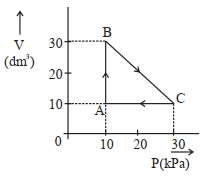
$(i)\, LiF > LiCl > LiBr > LiI$
$(ii)\, CaCl_2 < FeCl_2 < FeCl_3$
$(iii)Hg_2Cl_2 > HgCl_2$
$(iv)\, ZnCl_2 < CdCl_2 < HgCl_2$
$(v) CuCl < AgCl < AuCl$
$(vi) AlN > Al_2O_3 > AlF_3$
$(vii) CaF_2 < CaCl_2 < CaBr_2 < CaI_2$