MCQ
Which $C-$atoms is the most electronegative in this structure $\mathop {C{H_3}}\limits^{{\rm{III}}} - \mathop {C{H_2}}\limits^{{\rm{II}}} - C \equiv \mathop {CH}\limits^{\rm{I}} $
- ✓$I$
- B$II$
- C$III$
- DAll are equal electronegative
Elecronegativity $\propto$ $s$-character.
In $sp$ hybrid orbitals, $s$ character $=50\, \%$
and in $sp ^3$ hybrid orbitals, $s$ character $=33.3 \,\%$
Thus, option $I$ is the most electronegative.
Generate a complete, print-ready paper with questions like this in minutes — across 16+ boards, with answer keys.
| $(n)$-$(l)$-$(m)$-$(s)$ | |
| $(i)$ | $(3)$-$(2)$-$(1)$- $(+1/2)$ |
| $(ii)$ | $(2)$-$(2)$-$(1)$- $(+1/2)$ |
| $(iii)$ | $(4)$-$(3)$-$(-2)$- $(-1/2)$ |
| $(iv)$ | $(1)$-$(0)$-$(-1)$- $(-1/2)$ |
| $(v)$ | $(3)$-$(2$-$(3)$- $(+1/2)$ |
Which of the following sets of quantum number is not possible ?
[Given : $\mathrm{R}=0.083 \mathrm{~L} \mathrm{bar} \mathrm{mol}^{-1} \mathrm{~K}^{-1}$ ]
Assume complete dissociation of $\mathrm{NaCl}$
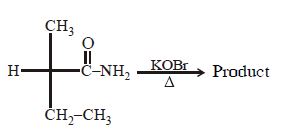
Reason $(R)$ : Extra stability to half filled electronic configuration is observed than incompletely filled electronic configuration.
In the light of the above statement, choose the most appropriate answer from the options given below: