MCQ
Which combination forms strongest ionic bond
- A$Ca^{+2}, Cl^-$
- B$K^+, O^{-2}$
- C$K^+, Cl^-$
- ✓$Ca^{+2}, O^{-2}$
$a)$ Ionic charge - the greater the product of the ionic charges. the stronger the bond.
$b)$ Ionic size - the lower the sum of the anion and cation radii, the stronger the bond.
$Ca ^{+2}$ and $O ^{-2}$ ions have smaller sizes and more charges compared to the rest. They will form a stronger ionic bond.
Therefore, the correct option is $D.$
Generate a complete, print-ready paper with questions like this in minutes — across 16+ boards, with answer keys.
( $p$ : pressure, $V$ : volume, $T$ : temperature, $H$ : enthalpy, $S$ : entropy)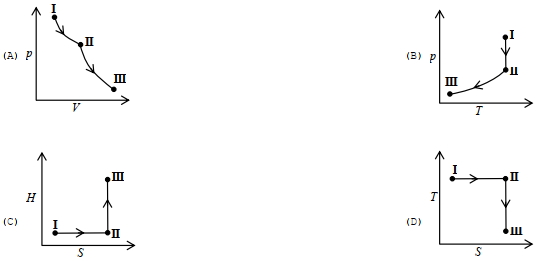
$2N_2O_5 \rightarrow 4NO_2 + O_2$ can be written in three ways.
$\frac{-d[N_2O_5 ]}{dt} = k[N_2O_5]$
$\frac{d[NO_2 ]}{dt} = k'[N_2O_5]\,;$ $\frac{d[O_2 ]}{dt} = k"[N_2O_5]$
The relationship between $k$ and $k'$ and betweenk and $k''$ are