MCQ
Which compound does not show geometrical isomerism
  • A
    $2-$butene
  • B
    $2-$pentene
  • C
    $2,3-$dibromo$-2-$butene
  • $2-$methyl propene

Answer

Correct option: D.
$2-$methyl propene
d
(d) $C{H_3} - \mathop {\mathop {C = }\limits_{|\,\,\,\,\,} C{H_2}\,\,\,\,\,\,\,}\limits_{C{H_3}\,\,\,\,\,\,\,\,\,\,\,\,\,\,\,\,\,\,\,\,} $

$2-$methyl propene does not show geometrical isomerism.

Need a full question paper?

Generate a complete, print-ready paper with questions like this in minutes — across 16+ boards, with answer keys.

Start Generating Free

Similar questions

The reason for "drug induced poisoning" is
$x{A_{(s)}} \rightleftharpoons y{B_{(g)}} + z{C_{(g)}}$ If $\frac{{{k_c}}}{{{k_p}}} = {\left( {RT} \right)^{ - 2}}$ , then which is correct 
Cellulose is a straight chain polysaccharide composed of only
Which of the following is correct
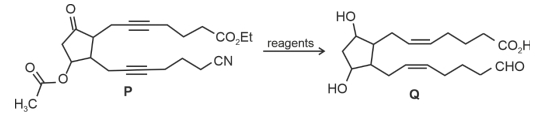
The option($s$) with correct sequence of reagents for the conversion of $P$ to $Q$ is(are)

$(A) i)$ Lindlar's catalyst, $H _2$; $ii$) $SnCl _2 / HCl$; iii) $NaBH _4$; iv) $H _3 O ^{+}$

$(B) i)$ Lindlar's catalyst, $H _2$; $ii$) $H _3 O ^{+}; iii)$ $SnCl _2 / HCl$; iv) $NaBH _4$

$(C) i)$ $NaBH _4; ii)$ $SnCl _2 / HCl; $iii$)$ $H _3 O ^{+}; iv)$ Lindlar's catalyst, $H _2$

$(D) i)$ Lindlar's catalyst, $H _2$; $ii$) $NaBH _4; iii)$ $SnCl _2 / HCl; iv)$ $H _3 O ^{+}$
Among $\left[ Ni ( CO )_4\right],\left[ Ni ( CN )_4\right]^2,\left[ Ni ( Cl )_4\right]^2$ species, thehybridisation states of the Ni is, respectively: (At. no. of $Ni =28$ ) :
For an exothermic reaction
Arrange the following elements in increasing order of first ionization enthalpy:

$\mathrm{Li}, \mathrm{Be}, \mathrm{B}, \mathrm{C}, \mathrm{N}$

Choose the correct answer from the options given below:

In a $500\,ml$ capacity vessel $CO$ and $C{l_2}$ are mixed to form $COC{l_2}$. At equilibrium, it contains $0.2$ moles of $COC{l_2}$ and $0.1$ mole of each of $CO$ and $C{l_2}$. The equilibrium constant ${K_c}$ for the reaction $CO + C{l_2}$ $\rightleftharpoons$ $COC{l_2}$ is
Which one of the following correctly represents the order of stability of oxides, $\mathrm{X}_{2} \mathrm{O} ;(\mathrm{X}=$ halogen $) ?$