MCQ
Which compound has electrovalent, covalent, co-ordinate as well as hydrogen  bond?
  • $[Cu(H_2O)_4]SO_4 · H_2O$
  • B
    $[Zn(H_2O)_6]SO_4 ·H_2O$
  • C
    $[Fe(H_2O)_6 ]SO_4 ·H_2O$
  • D
    $[Fe(H_2O)_6 ]Cl_3$

Answer

Correct option: A.
$[Cu(H_2O)_4]SO_4 · H_2O$
a
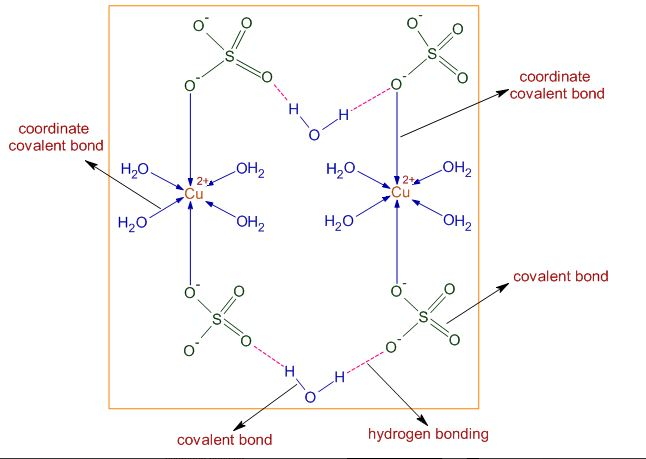
The structure of $\mathrm{CuSO}_{4} .5 \mathrm{H}_{2} \mathrm{O}$ in the solid-state is shown above. The $\mathrm{Cu}^{2+}$ ions are attracted towards $\mathrm{SO}_{4}^{2-}$ ions not only by ionic interactions (electrovalent) but also by coordinate covalent bonds.

The $\mathrm{Cu}^{2+}$ ions form coordinate covalent bonds with water as well as sulfate ions. There are covalent bonds in water and sulfate ions.
Need a full question paper?

Generate a complete, print-ready paper with questions like this in minutes — across 16+ boards, with answer keys.

Start Generating Free

Similar questions

Aqueous solution of $FeSO_4$ gives tests for both $Fe^{2+}$ and $SO_4^{2-}$ but after addition of excess of $KCN,$ solution ceases to give test for $Fe^{2+}.$ This is due to the formation of
The equivalent conductance at infinite dilution of a weak acid such as $HF$
If $m$ and $e$ are the mass and charge of the revolving electron in the orbit of radius $r$ for hydrogen atom, the total energy of the revolving electron will be
'Adsorption' principle is used for which of the following purification method?
The compound $X,$ in the reaction, is $ X\xrightarrow{{C{H_3}MgI}}Y\xrightarrow{{hydrolysis}}Mg(OH)I + C{H_3}COOH$
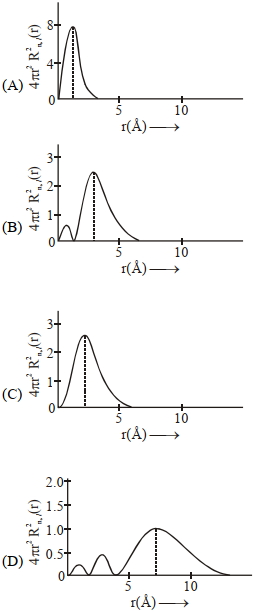
The plots of radial distribution functions for various orbitals of hydrogen atom against $'r ^{\prime}$ are given below

${image}$

The correct plot for $3\, s$ orbital is
Which of the following reactions is the metal displacement reaction? Choose the right option.
The hydrogen ion concentration in a given solution is $6 \times {10^{ - 4}}.$ Its $pH$ will be
To calculate the amount of work done in joules during reversible isothermal expansion of an ideal gas, the volume must be expressed in
Consider the following first order gas phase reaction at constant temperature

$\mathrm{A}(\mathrm{g}) \rightarrow 2 \mathrm{~B}(\mathrm{~g})+\mathrm{C}(\mathrm{g})$

If the total pressure of the gases is found to be $200$ torr after $23 \mathrm{sec}$. and $300$ torr upon the complete decomposition of $\mathrm{A}$ after a very long time, then the rate constant of the given reaction is . . . . . .$\times 10^{-2} \mathrm{~s}^{-1}$ (nearest integer)

[Given : $\log _{10}(2)=0.301$ ]