MCQ
Which crystal is used in the Davisson – Germer experiment?
- AAluminum
- BNickel
- CCobalt
- DZinc
Explanation:
The crystal used in the Davisson – Germer experiment is nickel. A fine beam of electrons is made to fall on the surface of the nickel crystal. As a result, the electrons are scattered in all directions by the atoms of the crystal.
Generate a complete, print-ready paper with questions like this in minutes — across 16+ boards, with answer keys.
In the following star circuit diagram (figure), the equivalent resistance between the points A and H will be
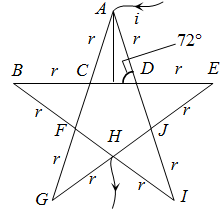
|
(a) 1.944 r |
(b) 0.973 r |
(c) 0.486 r |
(d) 0.243 r |
The cathode of a photoelectric cell is changed such that the work function changes from W1 to W2 (W2>W1). If the current before and after change are I1 and I2, all other conditions remaining unchanged, then (assuming hn > W2)
|
(a) |
(b) |
(c) |
(d) |
A source emits light of wavelength 4700Å, 5400 Å and 6500 Å. The light passes through red glass before being tested by a spectrometer. Which wavelength is seen in the spectrum
|
(a) 6500 Å |
(b) 5400 Å |
(c) 4700 Å |
(d) All the above |
Outside a nucleus
|
(a) Neutron is stable |
|
(b) Proton and neutron both are stable |
|
(c) Neutron is unstable |
|
(d) Neither neutron nor proton is stable |
The momentum of a photon is 2  gm-cm/sec. Its energy is
|
(a) 0.61 |
(b) 2.0 |
(c) 6 |
(d) 6 |
When  ampere current is passed in a tangent galvanometer, there is a deflection of 30° in it. The deflection obtained when 3 amperes current is passed, is
| (a) 30° | (b) 45° | (c) 60° | (d) 75° |


