MCQ
Which element gives maximum balanced oxide
  • A
    $V$
  • B
    $Cr$
  • $Mn$
  • D
    $Fe$

Answer

Correct option: C.
$Mn$
c
(c)Among the transition metals $Mn$  forms maximum no. of oxides.
$\mathop {MnO}\limits_{{\rm{basic}}} \,\,\,\,\mathop {M{n_3}{O_4}}\limits_{{\rm{amphoteric}}} \,\,\,\,\mathop {M{n_2}{O_3}}\limits_{{\rm{amphoteric}}} \,\,\,\,\mathop {Mn{O_2}}\limits_{{\rm{amphoteric}}} \,\,\,\,\mathop {M{n_2}{O_7}}\limits_{{\rm{acidic}}} $

Need a full question paper?

Generate a complete, print-ready paper with questions like this in minutes — across 16+ boards, with answer keys.

Start Generating Free

Similar questions

The product formed in the first step of the reaction of $\begin{array}{*{20}{c}} {Br\,\,\,\,\,\,\,\,\,\,\,\,\,\,\,\,\,\,} \\ {|\,\,\,\,\,\,\,\,\,\,\,\,\,\,\,\,\,\,\,\,\,\,} \\ {C{H_3} - C{H_2} - CH - C{H_2} - CH - C{H_3}} \\ {\,\,\,\,\,\,\,\,\,\,\,\,\,\,\,\,\,\,\,\,\,\,\,\,\,\,\,\,\,\,\,\,\,\,\,\,\,\,\,\,\,\,\,\,\,\,\,\,\,\,|} \\ {\,\,\,\,\,\,\,\,\,\,\,\,\,\,\,\,\,\,\,\,\,\,\,\,\,\,\,\,\,\,\,\,\,\,\,\,\,\,\,\,\,\,\,\,\,\,\,\,\,\,\,\,\,\,Br} \end{array}$ with excess $Mg / Et _{2} O \left( Et = C _{2} H _{5}\right)$ is
Metals react differently with water. The more vigorous is the reaction, the more is the bubble formation. The following diagram illustrates the reaction of sodium, magnesium and copper with water.
What can be concluded from this diagram?

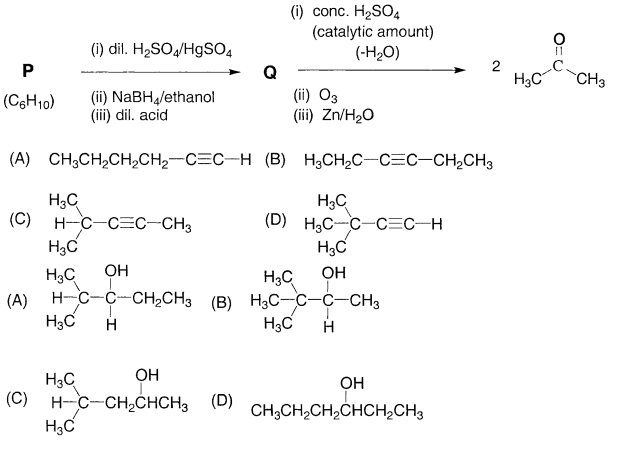
An acyclic hydrocarbon ${P}$, having molecular formula $\mathrm{C}_6 \mathrm{H}_{10}$, gave acetone as the only organic product through the following sequence of reactions, in which ${Q}$ is an intermediate organic compound. $Image$

$1.$ The structure of compound ${P}$ is

mcq $Image$

$2.$ The structure of the compound ${Q}$ is

mcq $Image$

Give the answer question $1,2$ and $3.$
The correct statement among the following is
Which one of the following alcohol will undergo acid catalysed dehydration with greatest ease by $E_1$ mechanism ?
A reaction takes place in three steps with individual rate constant and activation energy as follows 

     Rate constant     Activation energy
 Step $1$        $k_1$ $E_{a1} = 180\ kJ/mol$
 Step $2$        $k_2$ $E_{a2} = 80\ kJ/mol$
 Step $3$        $k_3$ $E_{a3} = 50\ kJ/mol$

If overall rate constant, $k = {\left( {\frac{{{k_1}{k_2}}}{{{k_3}}}} \right)^{2/3}}$  ,then overall activation energy of the reaction will be  .......... $ kJ/mol$
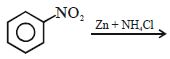
Product is
$NaOCl$ is used as a bleaching agent and sterilising agent. It can be synthesized by the action of
$ \mathrm{Ag}^{+}+\mathrm{NH}_3 \rightleftharpoons\left[\mathrm{Ag}\left(\mathrm{NH}_3\right)^{+}\right] ; \mathrm{k}_1=3.5 \times 10^{-3} $

$ {\left[\mathrm{Ag}\left(\mathrm{NH}_3\right)\right]^{+}+\mathrm{NH}_3 \rightleftharpoons\left[\mathrm{Ag}\left(\mathrm{NH}_3\right)_2\right]^{+} ; \mathrm{k}_2=1.7 \times 10^{-3}}$

then the formation constant of $\left[\mathrm{Ag}\left(\mathrm{NH}_3\right)_2\right]^{+}$is

In $Fe_2(CO)_9$, the two iron atoms are