MCQ
Which element having following electronic configurations has minimum ionization potential
- A$1{s^1}$
- B$1{s^2},\,2{s^2}\,2{p^6}$
- ✓$1{s^2},\,2{s^2}\,2{p^6},\,3{s^1}$
- D$1{s^2},\,2{s^2}\,2{p^2}$
It belongs to $IA$ group which has least ionization potential and it decreases down the group
Generate a complete, print-ready paper with questions like this in minutes — across 16+ boards, with answer keys.
Statement $I$ : The electronegativity of group $14$ elements from $\mathrm{Si}$ to $\mathrm{Pb}$ gradually decreases.
Statement $II$ : Group $14$ contains non-metallic, metallic, as well as metalloid elements.
In the light of the above statements, choose the most appropriate from the options given below :
Where $D$ is an isotope of hydrogen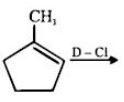
$(A)$ The $M ^{3+} / M ^{2+}$ reduction potential for iron is greater than manganese
$(B)$ The higher oxidation states of first row $d$ block elements get stabilized by oxide ion.
$(C)$ Aqueous solution of $Cr ^{2+}$ can liberate hydrogen from dilute acid.
$(D)$ Magnetic moment of $V ^{2+}$ is observed between $4.4-5.2\,BM$
Choose the correct answer from the options given below:
(Given : Molar mass in $\mathrm{g} \mathrm{mol}^{-1}$ Ethyl alcohol : $46$,
water : $18$)