MCQ
Which enzyme converts glucose and fructose both into ethanol
  • A
    Diastase
  • B
    Invertase
  • Zymase
  • D
    Maltase

Answer

Correct option: C.
Zymase
c
(c)$\mathop {{C_6}{H_{12}}{O_6}}\limits_{{\text{Glucose}}\,\,{\text{or}}\,\,{\text{Fructose}}} \xrightarrow{{{\text{Zymase}}}}\mathop {2{C_2}{H_5}OH}\limits_{{\text{Ethyl}}\,{\text{alcohol}}}  + 2C{O_2}$

Need a full question paper?

Generate a complete, print-ready paper with questions like this in minutes — across 16+ boards, with answer keys.

Start Generating Free

Similar questions

A source of monochromatic radiation of wavelength $400\, \mathrm{~nm}$ provides $1000\, \mathrm{~J}$ of energy in $10\, seconds.$ When this radiation falls on the surface of sodium, $\mathrm{x} \times 10^{20}$ electrons are ejected per second. Assume that wavelength $400\, \mathrm{~nm}$ is sufficient for ejection of electron from the surface of sodium metal. The value of $x$ is $......$. (Nearest integer) $\left(\mathrm{h}=6.626 \times 10^{-34}\, \mathrm{Js}\right)$
The element whose a atom has mass of $10.86 \times {10^{ - 26}}$ $kg$ is
Consider the following conversions :
$(i)\, O_{(g)} + e^- \to O_{(g)}^- , \Delta H_1$

$(ii)\, F_{(g)} + e^- \to F^-_{(g)}, \Delta H_2$

$(iii)\, Cl_{(g)} + e^- \to Cl_{(g)}, \Delta H_3$

$(iv)\, O_{(g)}^- + e^- \to O_{(g)}^{2-} , \Delta H_4$
That according to given information the incorrect statement is

The correct order for acidity of the following hydroxyl compound is:

Choose the correct answer from the options given below:
Total number of stereoisomers of the compound $1$ -bromo- $3$ -chlorocyclobutane is
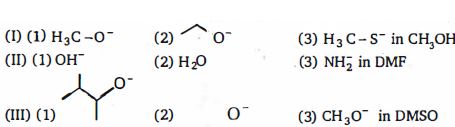
In each of the following groups, which is the strongest (best) nucleophile ?
Given that $E_{{K^ + }/K}^o\, = \, - \,2.93\,V\,;$

$E_{F{e^{2 + }}/Fe}^o\, = \, - \,0.44\,\,V\,;\,\,E_{Z{n^{2 + }}/Zn}^o\, = \, - \,0.76\,\,V\,;\,$

$E_{C{u^{ + 2}}/Cu}^o\, = \,0.34\,\,V$

Based on this data, which of the following is the strongest reducing agent ?

The incorrect order of lattice energy is
What is the ratio of glyoxal to pyrualdehyde obtained in the above reaction ?

(figure) $\xrightarrow[{(2)\,Zn}]{{(1)\,{O_3}}}\mathop {\begin{array}{*{20}{c}}
  {\,\,\,\,O\,\,\,\,\,\,\,O\,\,} \\ 
  {\,||\,\,\,\,\,\,\,\,\,||} \\ 
  {H - C - C - H} 
\end{array}}\limits_{Glyoxal}  + $ $\mathop {\begin{array}{*{20}{c}}
  {\,\,\,O\,\,\,\,\,O\,\,} \\ 
  {\,||\,\,\,\,\,\,\,\,||} \\ 
  {C{H_3} - C - C - C{H_3}} 
\end{array}}\limits_{2,3 - Bu\tan edione}  + \mathop {\begin{array}{*{20}{c}}
  {\,\,\,\,\,\,O\,\,\,\,\,O} \\ 
  {\,\,\,\,\,\,||\,\,\,\,\,\,||} \\ 
  {C{H_3} - C - C - H} 
\end{array}}\limits_{Pyrualdehyde} $

If $20\,g $ of a solute was dissolved in $ 500\,ml$  of water and osmotic pressure of the solution was found to be $ 600\,mm$  of $Hg  $ at ${15\,^o}C,$ then molecular weight of the solute is